
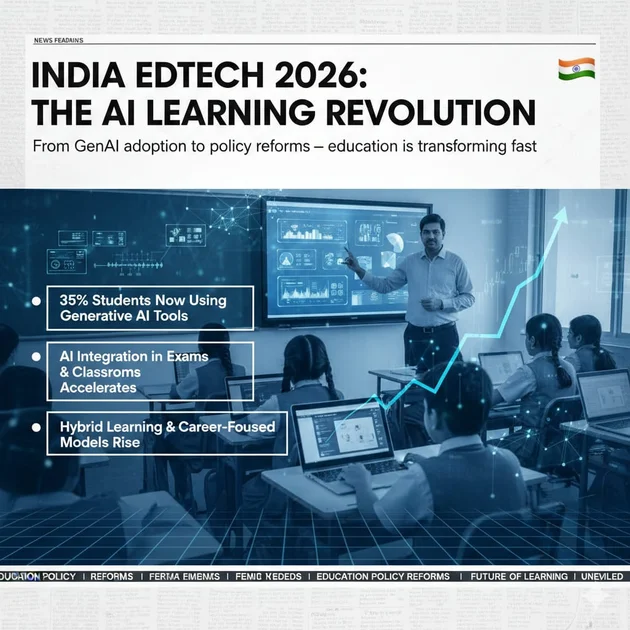
India EdTech Trends 2026: AI Integration, Policy Shifts, and the Rise of Hybrid Learning
Esha
Education Technology Experts
India EdTech Trends 2026: AI Integration, Policy Changes and Hybrid Learning on the Rise
By Esha Karmakar
In 2026 India’s EdTech sector is changing. The rapid digital growth that started during the pandemic is now evolving into a mature ecosystem. This change is driven by Artificial Intelligence, regulatory shifts, and hybrid learning models.
Industry reports suggest that 2026 is not just about expansion. It is about sustainability, responsibility, and measurable learning outcomes.
Let’s look at the trends in India’s EdTech sector that are reshaping education in 2026.
- AI Integration is key
- Policy shifts are happening
- Hybrid learning is becoming popular
1️⃣ Generative AI Adoption in Indian EdTech
Generative AI is becoming increasingly important in education in 2026.
Recent surveys indicate that 35% of students using EdTech platforms now rely on Generative AI tools for assignments, doubt resolution, and concept understanding. Adoption is especially strong among students from low-income households, signaling broader digital access.
However, challenges remain:
- Many students confuse Generative AI tools with traditional search engines.
- Over-reliance without critical thinking remains a concern.
This shift highlights the need for AI literacy within the Indian education system so students can use Generative AI tools responsibly and effectively.
3️⃣ PhysicsWallah’s Stock Listing and Market Growth
PhysicsWallah is now listed on the stock exchange, marking a turning point for India’s education technology sector.
The company reported:
- A 33% increase in profit during Q3 FY26
- ₹102 crore in net profit
This signals a broader shift from rapid expansion toward sustainable and profitable models.
For deeper insights into evolving digital learning models, read more about the role of online learning in K-12 education .
Other market developments include:
- Unacademy slowing offline expansion
- Byju’s continuing to face financial challenges
The sector is clearly transitioning from aggressive growth to operational maturity.
4️⃣ Government Initiatives: AI in Education
The government is actively promoting AI integration in education.
- The Ministry of Education is encouraging AI adoption in curricula.
- Microsoft is partnering to train 2 million teachers by 2030.
- The National Education Policy 2020 supports AI-based curriculum integration.
States are also innovating. Tamil Nadu is developing an AI-powered career guidance app for students in classes IX–XII.
AI in education is no longer experimental — it is becoming systemic.
5️⃣ Rise of AI-First Startups
AI-driven startups are reshaping learning experiences.
Former Flipkart executive Peeyush Ranjan launched Fermi.ai, an AI-first STEM learning platform that functions like a personalized tutor.
At the same time:
- Language-learning platforms are expanding into smaller towns.
- Companies like upGrad and Simplilearn are growing internationally across Southeast Asia and West Asia.
This reflects India’s emergence as a global education technology hub.
6️⃣ The Digital Divide: A Structural Challenge
Despite rapid AI adoption, infrastructure gaps remain a significant challenge.
- 1.52 lakh government schools still lack electricity.
- Internet connectivity remains inconsistent in many regions.
Artificial Intelligence cannot scale effectively without foundational digital access. Learn more about how AI is transforming education in this detailed blog on the benefits of AI in education .
Digital transformation must begin with universal access to electricity, internet, and digital infrastructure.
7️⃣ Industry Readiness and the Skill Gap
Employability remains a major concern in 2026. Reports suggest that 75% of higher education institutions are not fully industry-ready.
This creates pressure on EdTech companies to provide:
- Career-linked learning
- Job-oriented certifications
- Skill development programs
- Artificial Intelligence powered career mapping tools
The Education Technology sector is increasingly acting as a bridge between academia and industry. Explore how digital tools are shaping modern education here: Technology in Education: How Digital Tools Are Shaping Modern Learning .
For broader education updates and policy insights, read: India Education News 2026: Board Exams, AI Reforms and Admission Updates .
What 2026 Means for Indian Education Technology
In 2026, the Indian Education Technology ecosystem is evolving in three major ways:
- Artificial Intelligence is becoming essential.
- Companies are focusing on profitability over rapid expansion.
- Hybrid learning is emerging as the dominant model.
For sustainable progress, the sector must ensure:
- Ethical AI deployment
- Data privacy safeguards
- Human oversight in assessments
- Equal access to technology
The next phase of Indian Education Technology will not be defined by scale alone, but by responsibility, inclusion, and measurable learning outcomes.
Artificial Intelligence is transforming education. However, long-term success will depend on balanced innovation, strong governance, and human-centered implementation.
About the Author
Education Technology Experts
The Brilliyo editorial team shares insights on educational technology, learning management, and institution growth.
Related Articles
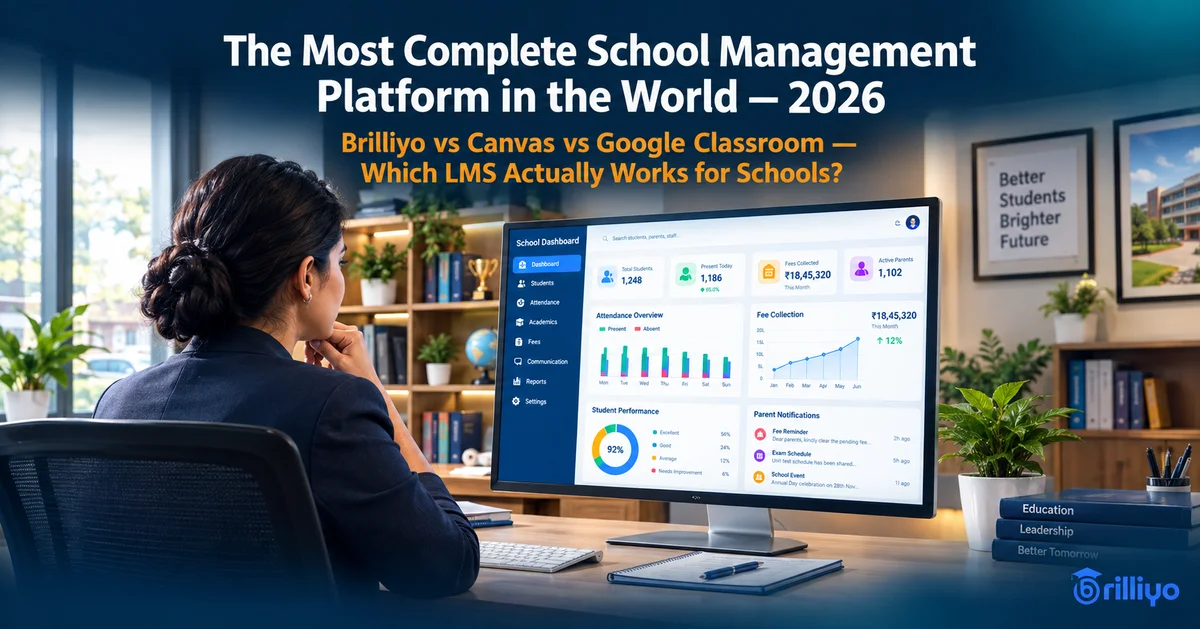
Best LMS Platforms in the World 2026 — And Why Brilliyo Is the Most Complete School Management Solution
Walk into any well-run school today and you will notice something that was not there ten years ago. The principal is not buried in paper files. The receptionist is not answering the same phone call for the third time this morning about fee due dates. The teacher is not carrying a bundle of registers under one arm and a stack of unmarked homework under the other.
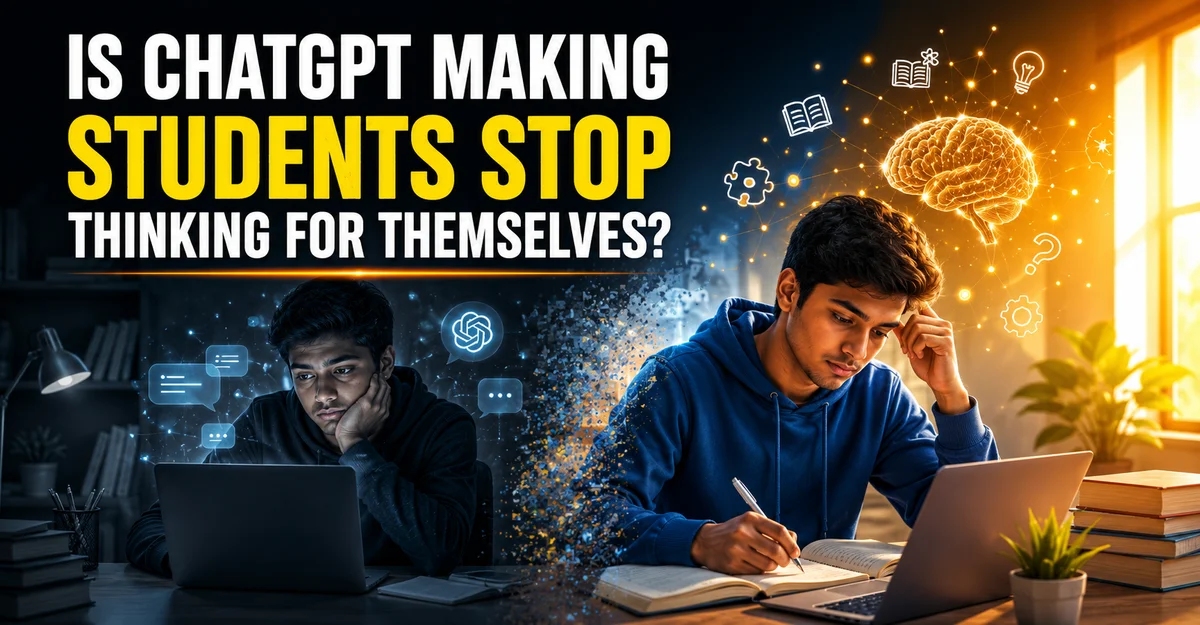
Is ChatGPT Making Students Stop Thinking for Themselves?
A student opens ChatGPT, types in their homework question copies the answer. Submits it. This whole process takes than two minutes. They do not have to think. They do not have to struggle. They do not learn.
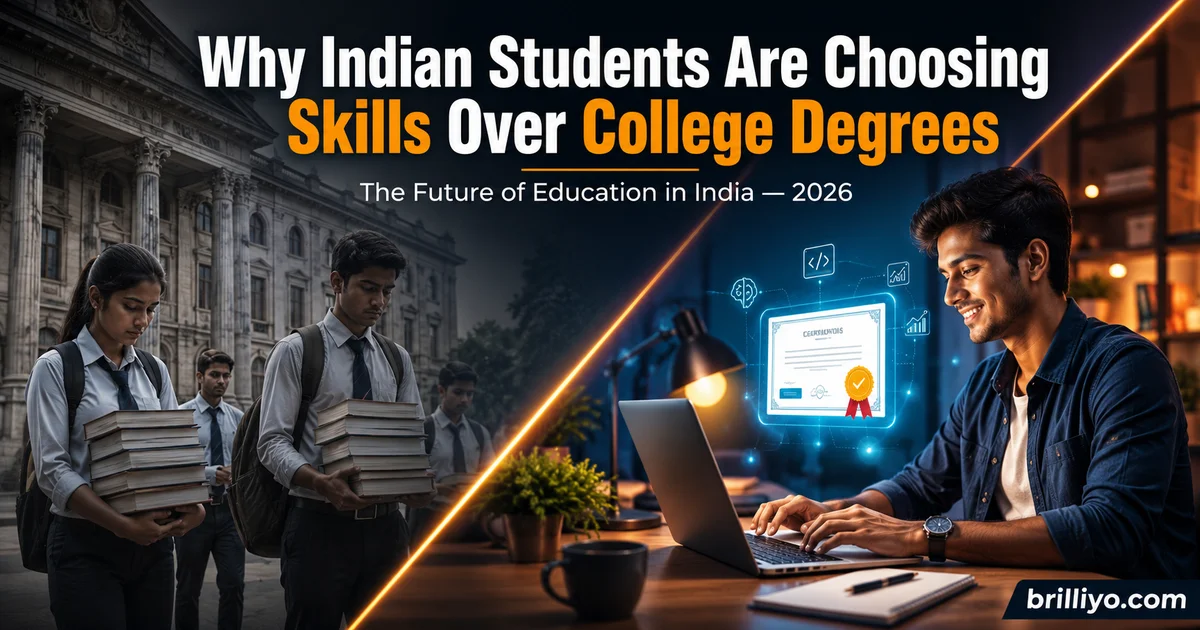
Why Indian Students Are Choosing Skills Over College Degrees
Something big is happening in India now. More and more young people in India are saying no to the college degree route and opting for learning skills instead. They are signing up for courses, vocational training, coding classes and special training for specific industries. And then they are getting jobs starting their own businesses and building careers that people with degrees are still waiting for.