

Top Challenges Schools Face Without School Management Software
Esha
Education Technology Experts
By Esha Karmakar
Schools have to manage students, teachers, parents, attendance, fees, examinations, and daily administrative work. Many schools still rely on paper records, spreadsheets, and traditional communication methods.
While these methods may work for smaller institutions, they often create major challenges as schools grow. This is why more educational institutions are adopting School Management Software to improve efficiency, organization, and communication.
Let's explore the biggest challenges schools face without a School Management System.
1. Administrative Work That Takes Too Much Time
Managing student records, attendance, fee collection, timetables, and reports manually consumes a significant amount of time.
Administrative staff often spend hours performing repetitive tasks that could easily be automated. This reduces productivity and increases the chances of human error.
Schools looking to improve efficiency should explore modern solutions such as School Management Software that help automate daily operations.
2. Attendance Tracking Becomes Difficult
Tracking attendance manually can be challenging, especially in large schools.
- Missing attendance records
- Human errors
- Delayed reporting
- Difficulty tracking attendance history
Without a digital system, attendance management becomes inefficient and time-consuming.
3. Poor Communication with Parents
Parents expect regular updates regarding their child's education.
Without a centralized communication platform, schools often struggle to share:
- Attendance updates
- Homework information
- Exam schedules
- School announcements
Poor communication can lead to misunderstandings and lower parent engagement.
4. Fee Management Issues
Manual fee collection often creates multiple challenges:
- Delayed payments
- Lost records
- Manual receipt generation
- Difficulty tracking pending fees
School Management Software helps automate fee collection, generate reports, and improve financial management.
5. Difficulty Managing Student Records
Schools must securely manage student information, including:
- Admission records
- Academic performance
- Attendance history
- Personal information
Paper-based records can easily get lost, damaged, or become difficult to access when needed.
Digital systems allow schools to retrieve information instantly and maintain accurate records.
6. Limited Access to Student Performance Data
Without technology, schools often struggle to analyze student performance effectively.
- Tracking academic progress
- Identifying struggling students
- Generating performance reports
- Monitoring long-term growth
Data-driven decision-making becomes difficult without proper software tools.
7. Challenges in Online and Hybrid Learning
Modern education increasingly depends on digital learning platforms.
Schools without Learning Management Systems (LMS) may face difficulties:
- Sharing study materials
- Conducting online classes
- Managing assignments
- Tracking student participation
This can negatively affect the overall learning experience for students.
Schools that combine technology with modern teaching methods can better support practical learning and skill-based education.
8. Increased Paperwork and Higher Costs
Manual operations require large amounts of paperwork.
- Higher printing costs
- Additional storage requirements
- Increased administrative workload
Digital systems reduce paperwork and help schools save both time and money.
9. Lack of Real-Time Reporting
School leaders need accurate information to make informed decisions.
Without software, generating reports can take significant time and effort.
- Attendance reports
- Fee reports
- Academic performance reports
- Staff management reports
Real-time reporting helps schools improve operational efficiency.
10. Difficulty Scaling School Operations
As a school grows, managing operations manually becomes increasingly difficult.
- More student records
- More communication requirements
- Additional administrative work
- Greater risk of errors
School Management Software helps institutions scale smoothly while maintaining efficiency and control.
Institutes that want long-term success should also focus on the key factors required to successfully run an educational institute.
Conclusion
Managing a modern school without School Management Software can create numerous challenges, including administrative delays, communication gaps, attendance issues, and higher operational costs.
By adopting a School ERP or Learning Management System, schools can automate routine tasks, improve communication, manage students more effectively, and provide a better educational experience.
In 2026, digital school management is no longer optional. It has become an essential part of running an efficient, organized, and future-ready educational institution.
```About the Author
Education Technology Experts
The Brilliyo editorial team shares insights on educational technology, learning management, and institution growth.
Related Articles
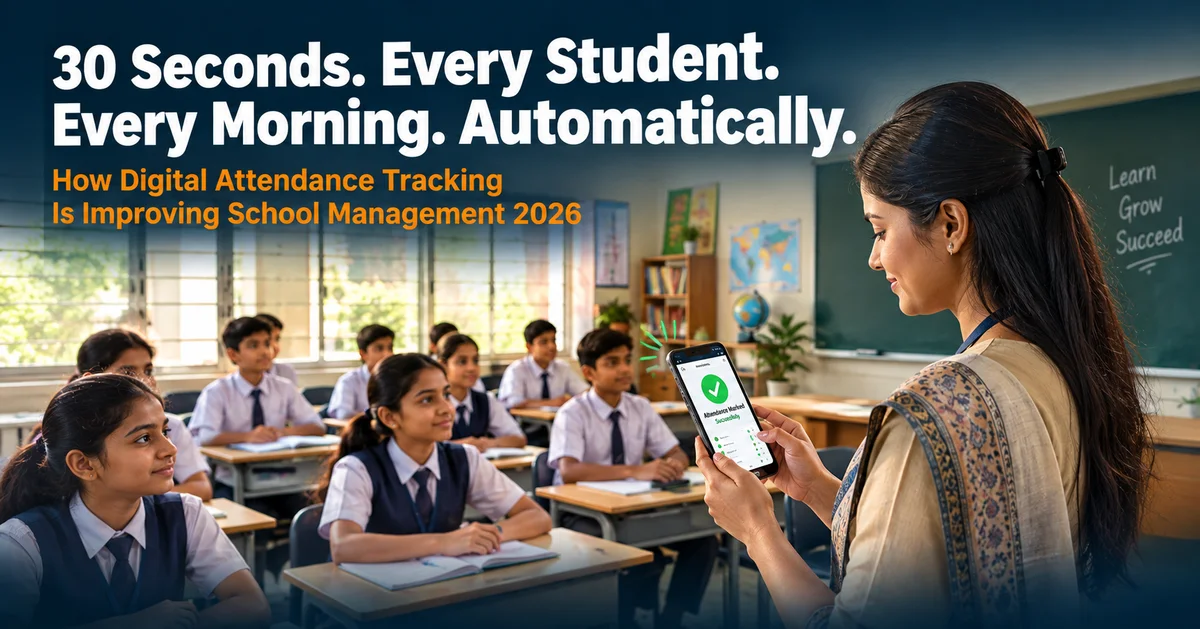
How Digital Attendance Tracking Is Improving School Management 2026
There is a moment that happens in almost every classroom, in almost every school, at almost exactly the same time every morning. The teacher asks for quiet. The register comes out. Names are called one by one. Students answer. Someone marks a tick or a cross in a column. The process takes five minutes on a good day and considerably longer when the class is restless, when a substitute teacher is covering, or when someone cannot find the register.

Top EdTech Trends That Are Changing Indian Schools in 2026
Education in India is changing a lot these days. This is because of the New Education Policy 2020 the fact that everyone is using things really fast and people want learning to be more about each student. So schools over India are thinking about how they teach students how they check what students know and how they help students. By 2026 technology will not just be something we use sometimes. It will be the way that schools teach students.

How Schools Can Reduce Dropout Rates Using Technology in 2026
Student dropout is a major challenge in schools today. Many students lose interest, struggle academically, or lack support—leading them to leave school early. In 2026, technology is helping schools solve this problem in smarter ways.