
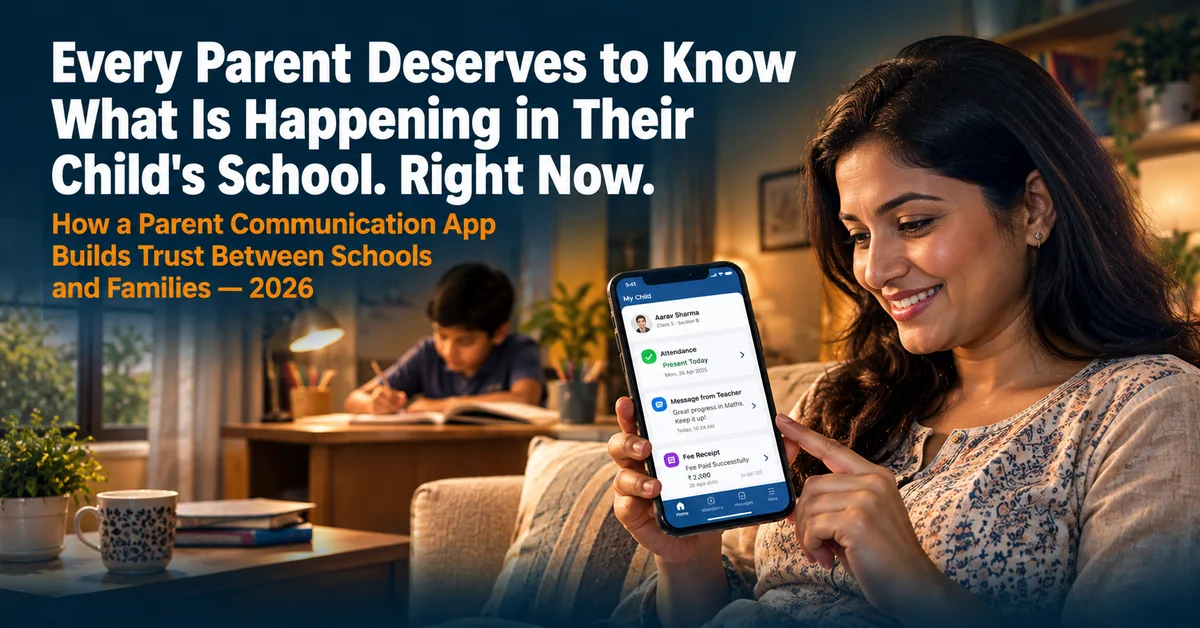
How a Parent Communication App Builds Trust Between Schools and Families

Esha
Content Writer & Education Technology Researcher
Think about the last time you felt genuinely informed about something that mattered to you.
Not the last time someone sent you a generic update. Not the last time you received information three days after it was relevant. The last time you actually felt that someone had taken the trouble to keep you properly in the loop — quickly, clearly and without you having to chase them for it.
That feeling is trust. And it is exactly what a well-run parent communication system builds between a school and the families it serves.
Most schools genuinely want to communicate well with parents. The intention is there. What is often missing is the infrastructure to make that communication consistent, timely and two-way — not just when there is a crisis or a report card, but every day, as a normal part of how the school operates.
A parent communication app is that infrastructure. And in 2026 the schools that have built their parent relationships on a proper communication platform are experiencing something that schools without one are not — families that feel connected, informed and genuinely confident in the institution their child attends.
The Communication Gap That Most Schools Have
There is a pattern that plays out in schools without a proper parent communication system that most school leaders will recognise immediately.
The school sends out a circular at the start of term. It goes home in school bags. Some families read it. Many do not. The information in it is already two weeks old by the time it reaches most parents.
An exam schedule changes. The school sends a message through whatever channel happens to be available — sometimes a text message, sometimes an email, sometimes a note in the homework diary. Some parents get it. Others miss it entirely and only find out on the morning of the exam.
A parent wants to know why their child received a lower grade than expected. They call the school. They are put on hold. They leave a message. The teacher calls back two days later. The conversation that could have taken five minutes has consumed a week of minor frustration for everyone involved.
None of this happens because the school does not care. It happens because the communication infrastructure is not good enough to support the relationship that both the school and the families want to have.
A parent communication app replaces this fragmented, unreliable system with something that works consistently — for every family, every day, regardless of what is happening in the school.
What a Parent Communication App Actually Does
At its core a parent communication app gives every family a single place where everything relevant to their child's school life is visible and where direct communication with the school is straightforward.
Attendance notifications arrive in real time. When a child is marked absent the parent knows within seconds — not at the end of the day, not when someone remembers to make a call, but immediately. The parent can respond directly through the app. The communication is logged. No phone tag. No missed messages.
Academic updates are available whenever a parent wants to see them. Current grades, recent assignment scores, upcoming assessment dates, progress notes from teachers — all visible in the app at any time. The parent does not have to wait for a scheduled parents evening or a termly report to understand how their child is doing. They can see it when it matters.
Fee information is transparent and current. Outstanding balances, payment history, upcoming due dates, digital receipts — all available through the same app. The parent does not need to call the school office to ask about their account. They can see it themselves.
School announcements reach every family immediately. A timetable change, a sports day postponement, a reminder about an upcoming event — sent through the app and received by every parent within seconds. Not dependent on children remembering to pass on a note. Not lost in an email inbox. Delivered directly.
Two-way communication is straightforward. A parent who has a question can send a message directly through the app. The teacher or administrator receives it, responds and the conversation is logged in one place. Both sides have a record of what was said and when.
🔗 Real-time attendance notifications to parents are one of the most immediate benefits of digital school management. Read more: How Digital Attendance Tracking Is Improving School Management 2026
Why This Changes the Parent Relationship
The relationship between a school and a family is built on something simple. Does the family feel that the school is taking care of their child and keeping them informed? Or do they feel that they are constantly trying to find out what is happening, never quite sure if they have the full picture?
The second experience — the feeling of being on the outside, of having to chase for basic information, of only hearing from the school when something has gone wrong — produces a specific kind of low-level anxiety in parents. It does not necessarily mean the school is doing a bad job educationally. But it creates distance. It makes parents less confident. It makes them more likely to assume the worst when something is unclear.
The first experience — knowing what is happening, receiving information proactively, being able to communicate easily and directly — produces something completely different. It produces trust. Not because the school is perfect, but because the school is transparent. Parents who feel informed feel included. Parents who feel included become advocates for the school rather than critics of it.
A parent communication app does not just make administration easier. It fundamentally changes the emotional experience of being a school parent — from feeling like an outsider who has to push for information to feeling like a genuine partner in their child's education.
What This Means for Schools
The benefits for schools are just as significant as the benefits for families.
When parents receive accurate, timely information through a dedicated app the volume of inbound enquiries drops significantly. Parents who can see their child's attendance, check their fee balance and read the latest school announcements without calling the office are not calling the office. The administrative team that was spending hours every week fielding basic information requests can redirect that time toward work that genuinely requires human involvement.
The quality of parent-teacher communication also improves. When messages are sent and received through a structured channel — rather than through a mix of phone calls, emails, paper notes and informal conversations at the school gate — conversations are more focused, better documented and easier to follow up on. Teachers spend less time repeating information and more time having genuinely productive conversations with families.
School events get better attendance. Exam preparations happen more consistently. Homework completion rates improve. These are not guaranteed outcomes but they are consistent patterns in schools where parent communication is working well. When families are better informed they are better able to support their child's learning — and that support makes a measurable difference.
🔗 Transparent fee communication through a parent app also reduces the time schools spend chasing payments. Read more: How Online Fee Management Software Is Saving Schools Hours Every Week
How Brilliyo's Parent Communication Works
Brilliyo's parent communication module is built into its complete school management platform — which means the information parents see in the app is live data from the same system that teachers and administrators are working in, not a separate feed that has to be manually updated.
When a teacher marks attendance in Brilliyo the absent notification reaches the parent's phone automatically. When a fee payment is recorded the receipt appears in the parent's app immediately. When a school administrator sends an announcement it goes to every parent simultaneously through the app. The information flow is automatic, accurate and consistent — because it comes from the same source that the school is already using to manage its operations.
Parents receive push notifications for the things that need immediate attention — an absence, an urgent announcement, a message from a teacher. They can check the app at their convenience for the information that does not require an immediate response — upcoming assessments, recent grades, fee statements, school calendar updates.
The messaging function allows parents to contact the school directly through the app. Messages go to the right person — a specific teacher, the administrative office, the school nurse — without the parent needing to find a phone number or send an email to a general inbox that might not be monitored promptly. Responses come back through the same channel. Both sides have a clear, dated record of the conversation.
School announcements can be targeted — sent to every parent in the school, to parents of a specific year group or to the parents of a particular class. A message about a Year 7 trip does not need to go to every family in the school. Brilliyo's communication tools make it straightforward to reach exactly the right audience with exactly the right information.
The Schools That Get This Right
There is a noticeable difference between schools that communicate well with parents and schools that do not — and it shows up in ways that go beyond parent satisfaction surveys.
Schools with strong parent communication tend to have fewer disputes about fees, grades and disciplinary decisions — not because those things never arise, but because parents who feel informed are less likely to assume that a problem has been hidden from them. They have context. They have a relationship with the institution. They approach concerns from a position of trust rather than suspicion.
These schools also tend to attract and retain families more effectively. In a world where parents research schools carefully before choosing one and share their experiences freely with other parents, the reputation that a school has for keeping families informed is a genuine competitive advantage. A parent who feels well looked after by their child's school tells other parents. That referral is worth more than any marketing.
And the staff in these schools report a different experience of parent interactions. When the baseline communication is good the conversations that happen at parents evenings, in response to reports or around specific concerns tend to be more constructive. The emotional temperature is lower. The trust is already established. There is less to prove on both sides.
Conclusion
A parent communication app is not a luxury feature of a well-run school. In 2026 it is part of the basic infrastructure that a school needs to maintain the kind of relationship with its families that makes everything else work better.
The trust between a school and its families does not build itself. It is built through consistent, timely, accurate communication — through parents feeling informed rather than kept in the dark, through two-way conversations that are easy rather than frustrating, through the daily accumulation of small signals that say the school takes its relationship with families seriously.
Brilliyo's parent communication tools are part of a complete school management platform — which means the communication improvements connect directly to improvements in attendance, fee management and academic oversight. Everything works together because it all comes from the same system.
For any school where the relationship with parents feels more strained than it should, where families seem less informed than the school intends them to be, where the administrative team is spending too much time on basic information requests — the parent communication app is where the improvement starts.
Frequently Asked Questions
What is a parent communication app for schools?
A parent communication app is a dedicated mobile application that gives school families real-time access to their child's attendance, academic progress, fee status and school announcements — and allows direct two-way communication between parents and school staff through a single platform.
How does a parent communication app build trust with families?
Trust builds when parents consistently receive accurate, timely information without having to chase it. A parent communication app delivers attendance notifications, academic updates, fee information and school announcements proactively — making families feel like informed partners in their child's education rather than outsiders who have to push for information.
What information can parents see in Brilliyo's parent app?
Through Brilliyo's parent app families can see their child's real-time attendance record, academic grades and progress, upcoming assessments, homework assignments, fee statements and payment history, school announcements and calendar updates — and can send and receive messages directly with teachers and school staff.
Does Brilliyo allow two-way communication between parents and teachers?
Yes. Brilliyo's messaging function allows parents to contact specific teachers or the school office directly through the app. Messages are received promptly, responses come back through the same channel and both sides maintain a clear dated record of the conversation.
Can schools send targeted announcements to specific year groups?
Yes. Brilliyo allows schools to send announcements to every parent in the school, to parents of a specific year group or to the parents of a particular class — making it straightforward to reach exactly the right audience without sending irrelevant messages to every family.
How does Brilliyo's parent communication connect to the rest of school management?
Brilliyo's parent app is built into the complete school management platform — which means the information parents see is live data from the same system that teachers and administrators use. Attendance notifications, fee receipts and academic updates reach parents automatically as the data is entered — with no manual update process required.
About the Author

Content Writer & Education Technology Researcher
Esha is a Content Writer specializing in EdTech, School ERP, Learning Management Systems (LMS), AI in Education, and digital learning. She creates SEO-focused educational content that helps schools and institutions embrace modern technology.
Related Articles

Top Career Options for Students After Class 12
Choosing a career after Class 12 is a decision. It can affect your opportunities, skills and growth. Students have career options in fields like technology, business, healthcare and creative industries. To pick the path think about what you like what you're good at and what you want to achieve.

Here is a 90-Day Study Plan for Competitive Exams. This is a Step-by-Step Guide.
To do well in exams like JEE, NEET UPSC, SSC, Banking or State-level entrance tests you need to have a good plan. It is not about studying hard. You need to study in a way that makes sense.