
How Real Time Analytics Is Helping School Principals Make Better Decisions

Esha
Content Writer & Education Technology Researcher
There is a particular kind of frustration that school principals know well.
It is the frustration of being responsible for something you cannot fully see.
You are responsible for the attendance of every student in your school. But the information about who is absent today, which classes have concerning patterns this term, which individual students have crossed a threshold that should trigger a conversation — that information is spread across registers, spreadsheets and individual teacher records. To get a complete picture you have to ask several people, wait for them to compile their data and then sit down with a report that was accurate as of last Thursday.
You are responsible for the academic performance of hundreds or thousands of students. But the data that tells you which year groups are performing below expectations, which subjects are producing consistently weak results, which individual students are slipping despite appearing to be fine — that data comes to you in termly or annual reports, long after the moment when an early intervention might have made a real difference.
You are responsible for the financial health of the school. But fee collection rates, outstanding balances and payment trends are locked in a finance system that someone else manages, in a format that requires a specific request and a waiting period before you can see what is happening.
This is what it looks like to lead a school without real time analytics. And in 2026 it is a more significant disadvantage than most principals fully appreciate — because the alternative is now well within reach of every school that chooses to use it.
What Real Time Analytics Actually Means for Schools
The term analytics can sound more complicated than the reality. In the context of running a school it means something specific and practical.
Real time analytics means having access to current, accurate data about what is happening in your school — not what was happening last week or last month, but right now — in a format that is easy to read, easy to act on and available on whatever device you happen to be holding.
It means opening a dashboard on your phone at eight in the morning and seeing attendance figures across every class before the first lesson has finished. It means noticing that a particular class has an unusually high absence rate today and being able to find out which students are absent before mid-morning. It means identifying the three students across the school whose attendance has dropped significantly over the past three weeks — early enough to have a meaningful conversation with their families before the situation becomes serious.
It means looking at assessment data by subject and year group and seeing immediately which areas need attention — not to blame teachers but to deploy support, to allocate resources and to have conversations grounded in evidence rather than impression.
It means having a live view of fee collection at the end of the month — total collected, total outstanding, families who have not responded to reminders — so that the finance conversation is about facts rather than approximations.
None of this is complicated. It is just information — the right information, in the right format, at the right time. What real time analytics does is make that possible consistently, without the manual effort that used to be required to produce even a fraction of it.
The Decisions That Get Better
When principals have access to real time data the quality of their decisions improves in ways that are specific and measurable.
Early identification of struggling students is the most significant. A student whose attendance begins declining in the third week of term is sending a signal. A student whose grades in mathematics have dropped consistently over six weeks is sending a signal. A student who has stopped engaging with homework assignments is sending a signal. In a school without analytics these signals get noticed — eventually — when a teacher raises a concern, when a report card reveals a problem, when a parent calls to ask why their child’s grade has fallen.
In a school with real time analytics these signals are visible in the data long before they surface in any other way. The principal or the relevant teacher can respond in week four rather than in week ten. That difference — six weeks of earlier intervention — changes outcomes in ways that a conversation at the end of the term simply cannot replicate.
Resource allocation is another area where real time data changes decisions. A subject that is consistently producing weak results across multiple year groups is telling the school something about how it is being taught, how it is being supported or how the curriculum is being delivered. Seeing that clearly in a dashboard — rather than inferring it from a mixture of anecdote and end-of-year results — allows school leaders to respond specifically and promptly.
Communication with parents improves when it is grounded in data. A parent meeting about a student’s performance is a different conversation when the principal or teacher has the complete picture — attendance alongside grades alongside communication history alongside health notes — compared to when they are working from memory and fragments. The conversation is more focused, more productive and more likely to result in a genuine plan.
What Most Schools Are Currently Using Instead
Most schools in 2026 are managing their analytics through a combination of spreadsheets, end-of-term reports and individual teacher observations. This is not through lack of effort — it is because the tools that would give them something better have not always been integrated into their school management platform.
The spreadsheet that tracks attendance is updated by a different person from the one who updates the academic record spreadsheet. The fee collection data sits in an accounting system that the principal cannot access directly. The communication log is in email inboxes and chat applications. The health records are in a filing cabinet or a separate system managed by the school nurse.
To produce a complete picture of any individual student a principal has to gather information from multiple sources, through multiple people, in a process that takes time they often do not have. To produce a school-wide picture — attendance trends, performance patterns, fee collection health — the same process has to happen at a larger scale, usually as a scheduled exercise at the end of a term rather than a live view available at any moment.
The irony is that all of this data already exists. It is being created every day by teachers, administrators and finance staff doing their jobs. What is missing is a system that brings it together in one place, updates it in real time and presents it in a format that a school leader can actually use to make decisions.
How Brilliyo’s Analytics Dashboard Works
Brilliyo’s school analytics module is built on top of its complete school management platform — which means the data it presents is not imported from external systems or compiled from spreadsheet exports. It is the same data that teachers are entering when they mark attendance, that the finance team is recording when they process fee payments, that administrators are updating when they log communications with families. The analytics are live because they come from systems that are already live.
When a principal opens the Brilliyo analytics dashboard they see current attendance across every class and year group — updated in real time as teachers complete their morning registers. They see fee collection figures for the current month alongside outstanding balances by year group. They see academic performance summaries that reflect the most recent assessments. They see communication activity — which families have been contacted recently, which have not responded to messages.
The dashboard does not just show aggregated figures. It enables the drill-down that makes analytics genuinely useful. A principal who sees that a particular year group’s attendance is lower than usual can click through to see which classes are affected, then which individual students are absent. That information was always there — in individual teacher registers — but accessing it used to require asking several people and waiting for responses. In Brilliyo it takes seconds.
Automated reports can be configured to run on whatever schedule the school needs — weekly attendance summaries sent to heads of year, monthly fee collection reports to the finance committee, termly academic performance overviews for the school board. These reports draw from the live system and reflect current data when they are generated, rather than being compiled manually from information that was collected at various points in the past.
The system also flags things that need attention without waiting for someone to notice them. A student whose attendance has dropped below a configured threshold receives an automatic flag. A class whose average performance in a recent assessment is significantly below the school-wide average is highlighted. A family that has not responded to three consecutive fee reminders appears on a follow-up list. These flags are not alerts that create panic — they are prompts that allow the right person to take the right action at the right time.
What This Means for School Leadership
The shift from reactive to proactive is the most important change that real time analytics brings to school leadership.
A principal who is working from monthly reports and end-of-term summaries is always, by definition, looking at history. The data tells them what happened. The response comes after the fact — after the student has already missed three weeks of school, after the year group has already produced a disappointing set of results, after the fee collection rate for the month has already fallen short.
A principal who has a live dashboard is working in the present. They see things as they are happening. They can intervene before the problem has fully developed. They can allocate resources to where they are needed before the need becomes critical. They can have conversations with families, teachers and year heads that are grounded in current reality rather than in what the last report said.
This is not a marginal improvement. It is a fundamentally different way of leading a school — one that is more responsive, more accurate and more effective at the thing that matters most: making sure every student gets the support they need, when they need it.
Conclusion
Data has always existed in schools. Teachers have always marked registers. Finance teams have always tracked payments. Administrators have always logged communications. The problem was never a shortage of data — it was a shortage of access, integration and timeliness.
Real time school analytics solves all three problems at once. It brings existing data together in one place, keeps it current and makes it accessible to the people who need to act on it — in a format they can actually use, on the device they happen to have in their hand.
Brilliyo’s analytics dashboard is part of a complete school management platform — which means the data it presents is not a layer added on top of existing systems. It is the natural output of a platform where attendance, fees, communication, academic assessment and student records all work together. The analytics are not something extra. They are what happens when everything else works properly.
For any school principal who is still making important decisions based on last month’s report — the upgrade is not as complicated as it might seem. And the difference it makes is not subtle.
About the Author

Content Writer & Education Technology Researcher
Esha is a Content Writer specializing in EdTech, School ERP, Learning Management Systems (LMS), AI in Education, and digital learning. She creates SEO-focused educational content that helps schools and institutions embrace modern technology.
Related Articles
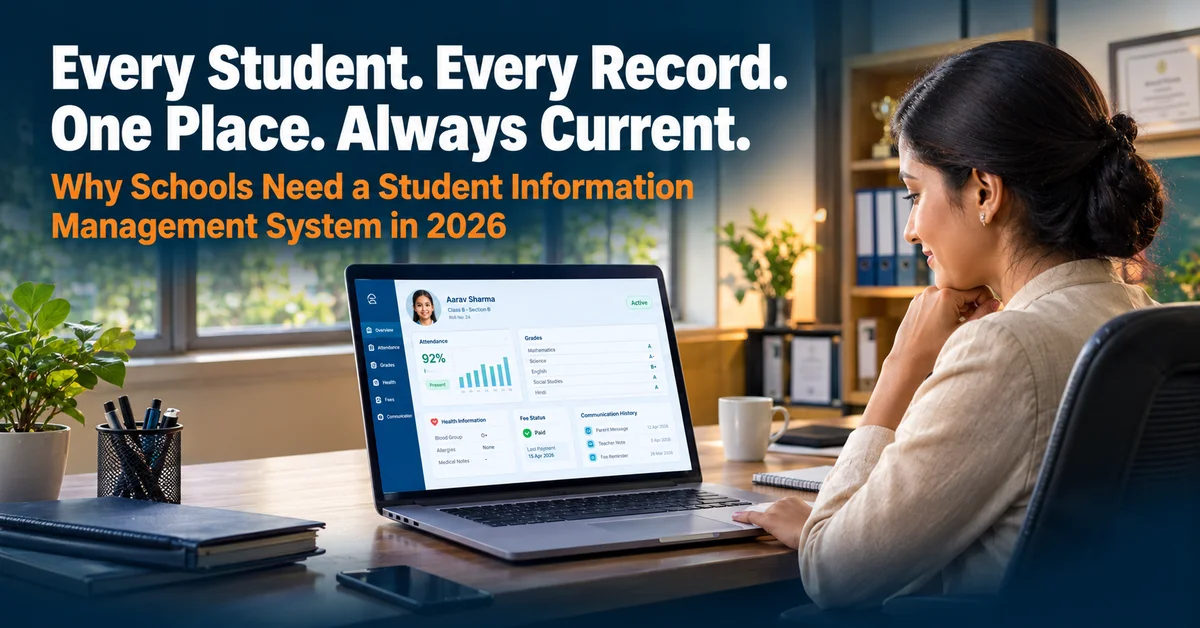
Why Schools Need a Student Information Management System in 2026
Somewhere in a school office right now someone is looking for a file. It might be a student's medical record that the school nurse needs urgently. It might be last year's attendance history that a teacher needs before a parent meeting this afternoon. It might be a fee payment record that a parent is disputing and the finance team cannot find quickly enough to give a confident answer.

Why Practical Learning Is Replacing Memorization
Education is changing very fast. Earlier students were mostly expected to memorize answers, formulas, and textbook definitions. Success in school was often measured by how much students could remember during exams.

Why Students Get Demotivated After a Days of Studying And How to Stay Consistent
Many students start studying with a lot of enthusiasm. They make plans, set targets and feel good.. After some days that enthusiasm fades away. They get sidetracked, stop following their schedule and feel stuck.