
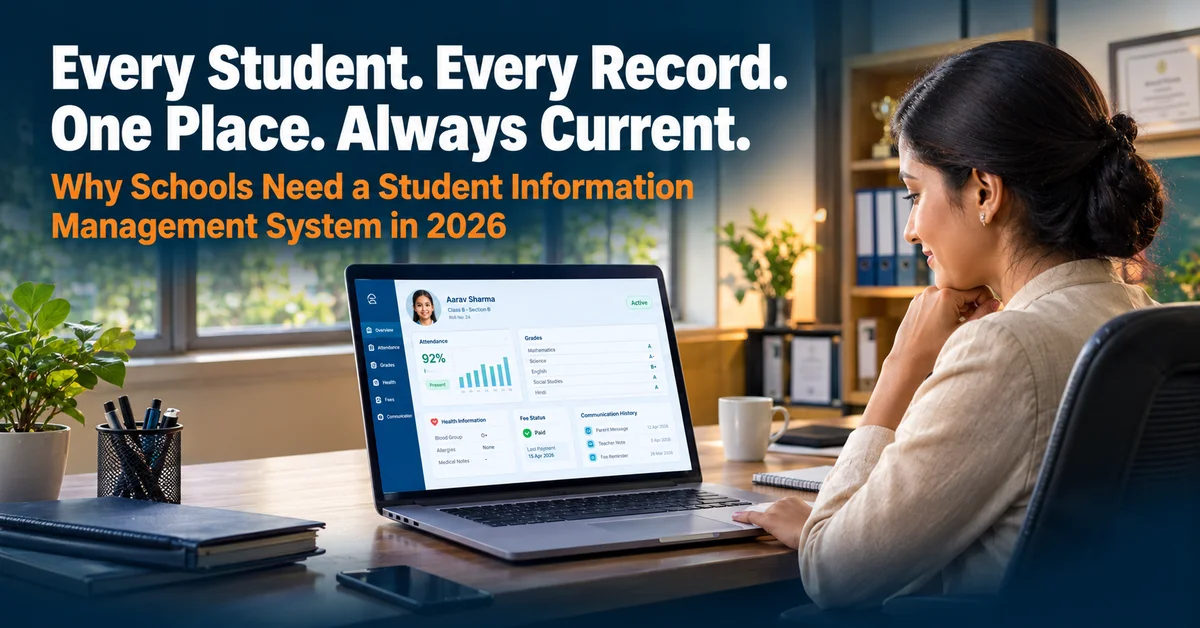
Why Schools Need a Student Information Management System in 2026
Gaurav Sharma
Blog content executive
Somewhere in a school office right now someone is looking for a file.
It might be a student's medical record that the school nurse needs urgently. It might be last year's attendance history that a teacher needs before a parent meeting this afternoon. It might be a fee payment record that a parent is disputing and the finance team cannot find quickly enough to give a confident answer.
The file exists. It was created at some point by someone who was doing their job carefully. But it is in a cabinet, or in a folder on a computer that the right person cannot access from where they are sitting, or in a register that was used two years ago and has since been archived. Finding it takes time. Sometimes it takes more time than the situation allows.
This is the daily reality of student information management in schools that have not yet moved to a proper digital system. And it is a reality that costs schools — in time, in accuracy, in the quality of decisions made without complete information, and in the professional impression they make on the families they serve.
A student information management system solves this. Not partially. Completely. And in 2026 the case for having one is stronger than it has ever been.
What Student Information Management Actually Involves
When people talk about student information management they are sometimes imagining something narrower than what it actually encompasses. It is not just a digital version of the admission register. It is not just a gradebook stored online.
Student information management covers everything a school knows about every student — and everything that school needs to be able to find quickly, share appropriately and act on decisively.
That includes the basics — name, date of birth, address, emergency contacts, admission date, year group, class. It includes the academic record — grades, assessment scores, report cards, teacher observations, learning support notes. It includes attendance history — every day present, every absence, every late arrival, every early departure, and whether each absence was explained or unexplained. It includes health and medical information — allergies, conditions, medication requirements, emergency protocols. It includes fee records — what has been charged, what has been paid, what is outstanding, and the complete payment history for every family. It includes communication records — every message sent to parents, every response received, every note logged by a teacher or administrator.
When all of this exists in a single system — properly organised, properly secured, accessible to the right people at the right time — a school operates with a level of clarity and confidence that simply is not possible when the same information is scattered across paper registers, filing cabinets, spreadsheets and individual teacher notebooks.
The Hidden Costs of Managing Student Information Badly
Schools that manage student information through manual or fragmented systems pay costs that rarely show up on a budget sheet but are very real in practice.
The first cost is time. Every time a staff member has to search for a piece of information — opening a register, scrolling through a spreadsheet, calling a colleague to ask where a file is — they are spending time that could be spent on something more valuable. Multiply this across every staff member, every day, and the cumulative cost is significant.
The second cost is errors. Information that lives in multiple places — a student's address in the admission register, the same address in a fee record, the same address again in an emergency contact list — is information that gets out of sync. One version is updated when the family moves house. The others are not. The next time someone needs the address in a hurry they may be looking at the wrong one.
The third cost is the decisions made without complete information. A teacher preparing for a difficult parent conversation who does not have quick access to the student's full attendance history, academic record and communication log is going into that conversation less prepared than they should be. A school leader reviewing a student's situation who cannot see the complete picture — academic performance, attendance pattern, fee status, health notes — is making decisions based on fragments rather than facts.
The fourth cost is the impression the school makes. A parent who asks a question about their child's record and receives a hesitant answer — or is asked to call back while someone finds the file — is forming a judgment about how professionally the school manages its responsibilities. That judgment matters.
🔗 Poor information management is part of a broader challenge facing schools that are still operating without proper systems in place. Read more: India Shut 94,000 Government Schools in a Decade — And the Children Who Paid the Price
What a Student Information Management System Changes
When a school moves its student information onto a proper management system the first thing that changes is access. The right information is available to the right person, on any device, in seconds.
A teacher who needs to check a student's medical notes before a field trip does not have to go to the school office and request a file. They open the system on their phone and the information is there. A finance team member who needs to check a family's complete payment history to respond to a query does not have to reconstruct it from multiple sources. It is all in one place, current and accurate. A principal who needs to understand the full picture of a student's situation — why attendance has dropped, what conversations have already happened with the family, whether there are health factors involved — can see all of it in one screen.
The second thing that changes is accuracy. When there is one record — one definitive, constantly updated digital profile for each student — the problem of conflicting information disappears. Updates happen once and are reflected everywhere. The address, the emergency contact, the grade record — they are all current because they all come from the same source.
The third thing that changes is the quality of decisions. When school leaders, teachers and administrators have complete, accurate, easily accessible information they make better decisions. They identify struggling students earlier. They communicate with families more effectively. They respond to concerns more confidently. They plan more accurately.
The fourth thing that changes is the relationship with families. A school that can answer a parent's question about their child's record immediately, accurately and completely — without hesitation, without putting the parent on hold, without promising to call back — is a school that communicates confidence and professionalism. That matters to parents in ways that show up in their trust and loyalty to the institution.
🔗 How a school communicates with parents is just as important as the information it holds about students. Read more: How a Parent Communication App Builds Trust Between Schools and Families
What Brilliyo's Student Information Management Does
Brilliyo's student information management module gives every student a complete digital profile from the moment they enrol — and keeps that profile current, accurate and accessible throughout their time at the school.
The profile brings together every piece of information the school holds about that student. Personal and family details. Academic history across every year and every subject. Attendance record updated in real time as teachers mark the daily register. Health and medical information with appropriate access controls. Fee records connected directly to the school's payment system. Communication history showing every message sent to the family and every response received.
This information is not held in separate modules that have to be opened and cross-referenced individually. It is a single, integrated profile. A teacher looking at a student's record sees their attendance alongside their grades alongside their recent communications alongside their health notes — because those things are not separate in the reality of understanding a student. They should not be separate in the system either.
Access is controlled carefully. Teachers see what they need for their teaching role. The school nurse sees the medical information. The finance team sees the fee records. The principal sees everything. The right information reaches the right people without exposing sensitive details to staff who do not need them.
When a student's family changes their address or phone number the update is made once and reflected everywhere. When a student moves to a different class their record moves with them. When a student leaves the school their complete record can be archived or transferred according to the school's requirements and applicable data protection obligations.
The Data Protection Dimension
Student information is sensitive. It involves minors. It includes medical details, financial information and personal family data. The responsibility to handle it properly is not optional — it is a legal and ethical obligation that schools carry on behalf of the families who trust them.
A student information management system that is properly designed addresses this responsibility directly. Access controls ensure that sensitive information reaches only the staff who need it. Encryption protects data in storage and in transit. Audit logs record who accessed what and when. Data retention policies determine how long records are kept and how they are disposed of when they are no longer needed.
Managing this level of data protection through paper records and spreadsheets is genuinely difficult. The paper file that contains a student's medical history has no access log. The spreadsheet that holds fee records has no encryption. The information is not protected in the way that the families who provided it have every right to expect.
A proper system built for schools handles these responsibilities by design rather than as an afterthought. Brilliyo stores all student data on encrypted cloud infrastructure that meets data protection standards across multiple countries — so that whatever jurisdiction a school operates in, the families it serves can be confident that their children's information is being handled with the care and security it deserves.
Conclusion
Student information management is not a glamorous topic. It does not generate the same conversation as artificial intelligence in classrooms or the future of online learning. But it is foundational. It is the difference between a school that knows its students — completely, accurately, in real time — and a school that is always catching up, always searching for the file, always making decisions with incomplete information.
In 2026 there is no reason for a school of any size, in any country, to still be managing student information through paper registers and fragmented spreadsheets. The tools exist. The benefits are clear. The costs of not having a proper system in place — in time, in errors, in decisions made without complete information and in the professional impression the school makes on the families it serves — are real and they compound every year.
Brilliyo's student information management is part of a complete school management platform — which means the student profile is not an isolated record. It connects to attendance, to fee management, to parent communication, to academic assessment and to school analytics. The information does not sit in a silo. It informs everything.
For any school where someone is still looking for the file — this is where that problem ends.
Frequently Asked Questions
What is a student information management system for schools?
A student information management system is a digital platform that centralises all the information a school holds about every student — personal and family details, academic records, attendance history, health information, fee records and communication history — in a single secure profile that authorised staff can access instantly from any device.
How is a student information management system different from a school register?
A school register records basic attendance or enrolment information in one format. A student information management system brings together every aspect of a student's school life — academic performance, attendance, health, fees, communications and more — in an integrated profile that updates in real time and connects to every other function the school manages.
Can different staff members see different information in Brilliyo's student profiles?
Yes. Brilliyo uses role-based access controls to ensure that each staff member sees the information relevant to their role. Teachers see academic and attendance data. The school nurse sees health records. Finance staff see fee records. The principal has access to the complete profile. Sensitive information is protected from staff who do not need it.
How does student information management improve school decision-making?
When school leaders, teachers and administrators have complete, accurate and easily accessible student information they make better decisions — identifying struggling students earlier, communicating with families more effectively, responding to concerns more confidently and planning more accurately. Decisions made with complete information are consistently better than decisions made with fragments.
Is student data secure in Brilliyo?
Yes. Brilliyo stores all student information on encrypted cloud infrastructure that meets data protection standards across multiple countries. Access is controlled, audit logs are maintained and data is handled with the security and responsibility that families and school leaders expect.
Does Brilliyo's student information management work for schools of all sizes?
Yes. Brilliyo is designed to scale effectively from smaller schools with a few hundred students to large institutions with thousands. The system manages student profiles consistently regardless of school size and connects seamlessly to the other functions of the complete school management platform.
About the Author
Blog content executive
Creative and detail-oriented Blog Content Executive skilled in creating engaging, informative, and SEO-friendly blog content. Experienced in content research, keyword integration, blog planning, editing, and maintaining consistent brand tone. Passionate about creating valuable content that attracts readers, improves engagement, and supports website growth.
Related Articles
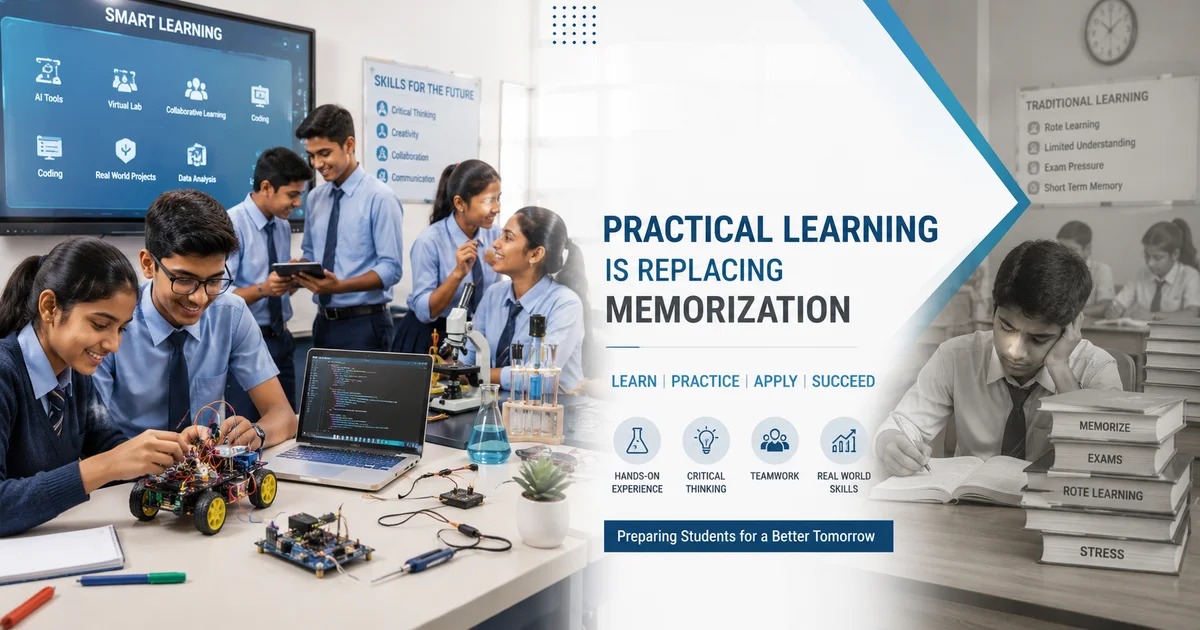
Why Practical Learning Is Replacing Memorization
Education is changing very fast. Earlier students were mostly expected to memorize answers, formulas, and textbook definitions. Success in school was often measured by how much students could remember during exams.

Why Students Get Demotivated After a Days of Studying And How to Stay Consistent
Many students start studying with a lot of enthusiasm. They make plans, set targets and feel good.. After some days that enthusiasm fades away. They get sidetracked, stop following their schedule and feel stuck.

How Students Can Stay Consistent in Studies and Improve Results
Staying consistent in studies is a problem, for students. A lot of students start with motivation. Then they lose focus after a few days. To do well students need to work every day not just sometimes. If students can stay consistent in their studies they can do better feel less stressed and get results. Students can really improve their studies if they stay consistent in their studies.