
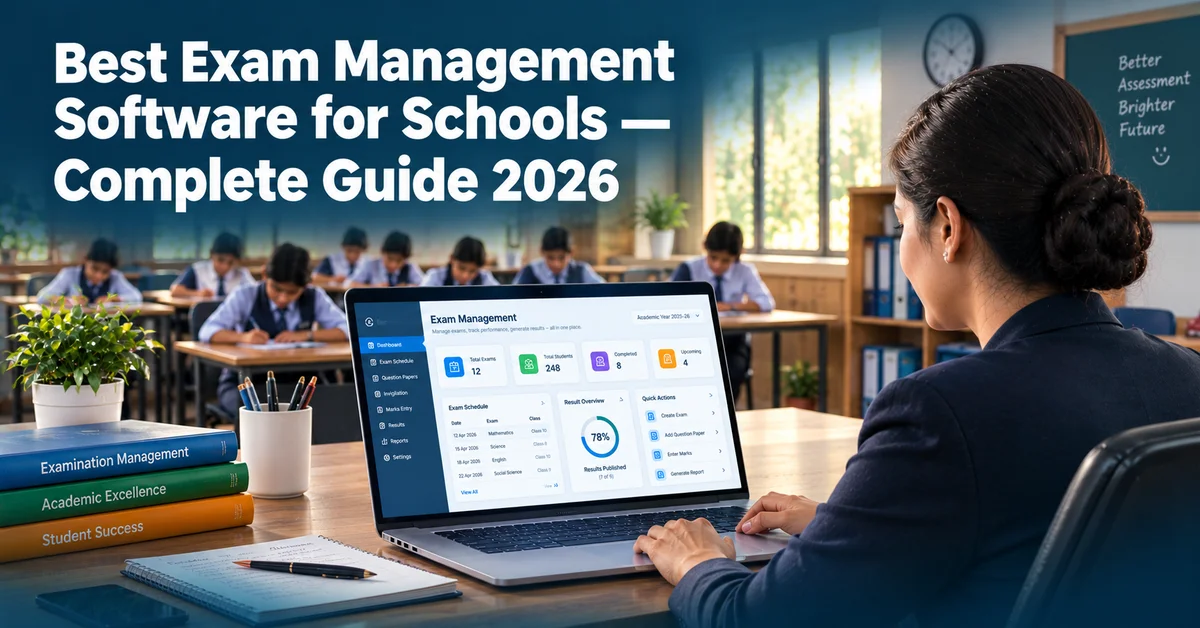
Best Exam Management Software for Schools — Complete Guide 2026

Esha
Content Writer & Education Technology Researcher
Exam season in most schools follows a pattern that anyone who has worked in school administration will recognise immediately.
Weeks before the exams begin someone has to create the question papers — drawing from a syllabus, ensuring appropriate coverage, setting difficulty levels and getting the papers reviewed and approved. Then the papers have to be printed, stored securely and distributed without any possibility of leakage. The exam hall has to be arranged, invigilators assigned, seating plans created and students informed of their hall and seat numbers.
On the day itself attendance has to be marked, any students with special arrangements have to be accommodated, and the logistics of collecting papers at the end have to be managed without confusion. Then the marking begins — stacks of answer sheets distributed among teachers, each marking their section, results compiled from multiple sources and entered into a system that will eventually produce the final scores.
Then the results have to be tabulated, verified, formatted into report cards and communicated to students and parents. Any errors discovered in the tabulation have to be corrected. Any grade disputes have to be investigated against the original scripts.
This entire process — from question paper creation to results communication — takes weeks of effort from multiple members of staff, creates multiple opportunities for error and consumes administrative time that most schools simply do not have to spare. And it happens multiple times every academic year.
Exam management software exists to transform this process. In 2026 the schools that have moved to a proper digital examination system are not just saving time — they are delivering a more accurate, more transparent and more professional examination experience to their students and families.
What Exam Management Software Actually Does
The term exam management software covers a wider range of functions than most school administrators initially expect. It is not just a tool for conducting online tests. A complete examination management system handles every stage of the examination process — from the creation of the question paper to the publication of results.
Question paper creation is where the process starts. A good exam management system includes a question bank — a library of questions organised by subject, topic, difficulty level and question type — from which teachers can either manually select questions or have the system generate a paper automatically based on specified parameters. This makes the process of creating a well-balanced, curriculum-aligned question paper significantly faster and more consistent than building one from scratch each time.
Exam scheduling and communication is the next stage. The system maintains the examination timetable, sends automatic notifications to students and parents about upcoming exams, manages hall and seat assignments and tracks which students have received which notifications. The administrative work of informing every family about every exam date, time and location — which in a manual system is a significant effort — is handled automatically.
For schools conducting online examinations the system delivers the question paper to students through a controlled digital environment. Features like browser lockdown prevent students from accessing other applications or websites during the exam. Time limits are enforced automatically. Question randomisation reduces the possibility of students sharing answers. Responses are collected and stored securely the moment the exam ends.
Answer evaluation — whether manual or automated — is managed through the system. For objective questions the system marks automatically and immediately. For written answers teachers mark through a digital interface that presents each response clearly, maintains marking consistency and records marks directly in the system without any need for manual transfer or data entry.
Result compilation and publication happens automatically as marking is completed. The system calculates final scores, applies any weighting or formula the school has configured and generates results in whatever format the school requires — individual student reports, class summaries, subject performance analyses. Results reach parents through the school’s communication channel the moment they are ready.
Why Manual Exam Management Costs Schools More Than They Realise
The true cost of managing examinations manually is spread across so many different activities that it rarely gets added up and looked at as a single figure. But the cumulative picture is significant.
The time that teachers spend creating question papers from scratch — when a question bank could generate a well-structured paper in minutes — is time not spent on teaching, preparation or the pastoral care of students. Across a school year, across all the examinations that take place, this adds up to a considerable number of hours.
The administrative effort of creating seating plans, printing hall tickets, distributing papers, collecting scripts, distributing scripts among markers, collecting marked scripts, tabulating results from multiple sources and checking the tabulation for errors — each of these steps takes time and each creates an opportunity for a mistake that then takes more time to identify and correct.
The errors themselves carry costs beyond the time required to fix them. A student who receives an incorrect grade and raises a dispute creates a process — investigation, re-marking, correction, re-communication — that is time-consuming for everyone involved and damaging to the school’s relationship with that family. A data entry error in result tabulation that is not caught before results are published creates exactly that situation, repeatedly.
The communication gaps that manual examination management creates also matter. Parents who are not reliably informed about exam dates and times, who do not receive results until days or weeks after marking is complete, who have no straightforward way to raise a query about their child’s result — these parents are forming a view of the school’s professionalism from every one of those interactions. The impression made is not always the one the school intends.
🔗 The same principles that make exam management better also apply to how schools deliver their broader curriculum online. Read more: Best LMS for Schools — Complete Guide 2026
What to Look for in Exam Management Software for Schools
Not all exam management software is built with schools in mind. Much of what is available in the market was designed for universities, professional certification bodies or corporate training environments. Before evaluating specific platforms schools should be clear about what a school-appropriate examination management system needs to provide.
Age-appropriate design matters in a way that is sometimes overlooked. An interface designed for adult professionals sitting a certification exam is not the right environment for a twelve-year-old sitting a term assessment. The platform needs to be accessible and non-intimidating for students at whatever age the school serves.
Integration with school management is more important than most schools appreciate until they are already committed to a system. An examination platform that sits in isolation from student records, attendance, parent communication and analytics creates the same problem as an isolated LMS — data has to be managed in two places, results have to be communicated through a separate channel and the complete picture of a student’s performance is never in one place.
Flexibility for different examination formats matters because schools do not run only one type of assessment. Multiple choice, short answer, essay, practical assessment, project submission — a complete exam management system needs to handle the full range of formats that a school uses rather than being optimised for a single type.
Security features appropriate to the school context are essential. For high-stakes internal examinations the system needs to prevent unauthorised access to papers before the exam, prevent sharing of answers during the exam and maintain the integrity of results data after the exam. These are not optional features — they are the minimum requirement for a system that is going to be trusted with assessments that affect students’ academic progression.
Ease of use for teachers and administrators determines whether the system actually gets used. A platform that is technically impressive but requires extensive training to use will be adopted inconsistently. The teachers and administrators who will use it every day are not technical specialists — the system needs to work for them as they are, not as they would be if they had unlimited time for training.
How Brilliyo Handles Exam Management
Brilliyo’s examination management module is built into its complete school management platform — connected directly to student records, parent communication and school analytics rather than operating as a separate system that has to be managed alongside everything else.
The question bank in Brilliyo allows teachers to build a library of questions organised by subject, topic, difficulty and type. Creating a new exam paper means selecting from this bank — either manually or through the automatic generation function that creates a balanced paper based on the parameters the teacher specifies. Papers can be reviewed and approved before they are published. Question randomisation can be applied so that different students receive the same questions in a different order.
Exam scheduling in Brilliyo connects directly to the school calendar and the parent communication system. When an exam is scheduled notifications go automatically to every relevant student and parent — date, time, subject, location. Reminders go out as the date approaches. Parents who have not acknowledged the notification can be followed up through the same channel. The information reaches every family reliably without any additional effort from the administrative team.
For online examinations Brilliyo delivers the paper through a controlled environment with configurable security settings. Time limits are enforced automatically. The moment the exam ends responses are collected, stored and ready for evaluation. For objective questions marking happens immediately and results are available without any delay. For written questions the marking interface presents each response clearly to the relevant teacher, records marks directly in the system and tracks marking progress so that the administrative team can see exactly where the process stands at any point.
Result compilation in Brilliyo is automatic. As marking is completed the system calculates final scores, applies any formula the school has configured and makes results available to school leaders for review and approval before publication. Once approved results are published directly to students and parents through the Brilliyo parent app — instantly, accurately and without any manual communication effort.
The analytics that Brilliyo generates from examination data connect directly to the school-wide analytics dashboard. Performance by subject, by class, by year group and by individual student sits alongside attendance and other data — giving school leaders the complete picture they need to understand how students are progressing and where intervention is needed.
🔗 Examination data becomes most powerful when it sits alongside everything else a school knows about its students. Read more: How Real Time Analytics Is Helping School Principals Make Better Decisions
The Schools Getting This Right
The schools that have the most positive experience of exam management software share a characteristic that is worth noting. They did not implement the software and then try to make their existing examination processes fit it. They used the implementation as an opportunity to review how their examinations were being managed and to redesign the process around what the platform made possible.
A school that digitises a poorly designed manual process ends up with a poorly designed digital process. A school that rethinks the process — asks what the examination experience should look like for students, parents and teachers, and then configures the platform to deliver that — ends up with something genuinely better.
This is a different kind of implementation. It takes more thought at the beginning. But the outcome is a system that the whole school uses confidently, that delivers a professional examination experience and that frees up the administrative time that used to be consumed by the manual process.
Conclusion
Exam management is one of the most administratively demanding things a school does. It happens multiple times every year, it involves significant numbers of staff, it carries real consequences for students and it creates real risks — of errors, of delays, of communication failures — that manual processes are poorly equipped to manage.
Exam management software does not just reduce the administrative burden. It changes the quality of the examination experience for everyone involved. Students receive clear, timely information and results. Parents are kept informed throughout the process. Teachers spend less time on administrative tasks and more time on what matters. School leaders have better data and fewer things to worry about.
Brilliyo’s examination management is part of a complete school management platform — which means the improvements it delivers connect directly to everything else the school is managing. The results that students achieve in exams sit in the same system as their attendance, their learning activity and their communication history. The examination data informs the analytics. The communication about exams uses the same channel that parents already trust for everything else.
For any school that is still managing examinations through paper, spreadsheets and manual processes — the upgrade is more straightforward than it might seem. And the difference it makes, to every person involved in the examination process, is significant from the first exam cycle.
Frequently Asked Questions
What is exam management software for schools?
Exam management software is a digital platform that handles the complete examination process — from question paper creation and exam scheduling through online or paper-based assessment delivery, digital marking, result compilation and publication to students and parents. It replaces the manual processes that consume significant staff time and create multiple opportunities for error.
What features should schools look for in exam management software?
Schools should look for a question bank with organised content, flexible exam formats for different assessment types, scheduling with automatic parent and student notification, online exam delivery with appropriate security features, digital marking tools, automatic result compilation and publication and integration with the school’s broader management platform.
How does online exam management prevent cheating?
Good online exam management software uses browser lockdown technology to prevent students accessing other applications or websites during the exam, question randomisation so different students see questions in different orders, time limits enforced automatically and secure collection of responses the moment the exam ends.
How does Brilliyo’s exam management connect to parent communication?
When an exam is scheduled in Brilliyo notifications go automatically to relevant students and parents through the Brilliyo parent app — the same channel used for attendance updates, fee information and school announcements. Results are published through the same channel the moment they are approved without any separate communication effort required.
Can Brilliyo handle both online and paper-based examinations?
Yes. Brilliyo’s examination management module supports both online assessment delivery and the administrative functions — scheduling, seating, result recording and publication — that apply to paper-based examinations. Schools can use whichever format suits each assessment without changing platforms.
How does exam performance data appear in Brilliyo’s analytics?
Examination results in Brilliyo connect automatically to the school analytics dashboard. Performance by subject, class, year group and individual student is visible alongside attendance and other school data — giving school leaders the complete picture they need to understand how students are progressing and where additional support is needed.
About the Author

Content Writer & Education Technology Researcher
Esha is a Content Writer specializing in EdTech, School ERP, Learning Management Systems (LMS), AI in Education, and digital learning. She creates SEO-focused educational content that helps schools and institutions embrace modern technology.
Related Articles
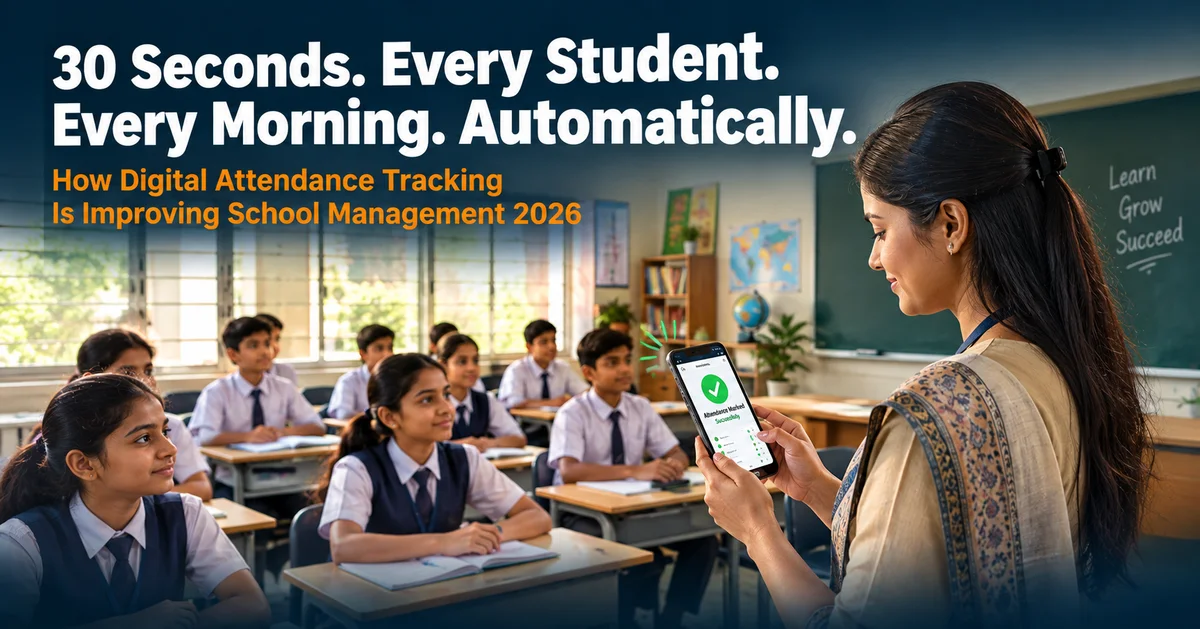
How Digital Attendance Tracking Is Improving School Management 2026
There is a moment that happens in almost every classroom, in almost every school, at almost exactly the same time every morning. The teacher asks for quiet. The register comes out. Names are called one by one. Students answer. Someone marks a tick or a cross in a column. The process takes five minutes on a good day and considerably longer when the class is restless, when a substitute teacher is covering, or when someone cannot find the register.

Top EdTech Trends That Are Changing Indian Schools in 2026
Education in India is changing a lot these days. This is because of the New Education Policy 2020 the fact that everyone is using things really fast and people want learning to be more about each student. So schools over India are thinking about how they teach students how they check what students know and how they help students. By 2026 technology will not just be something we use sometimes. It will be the way that schools teach students.
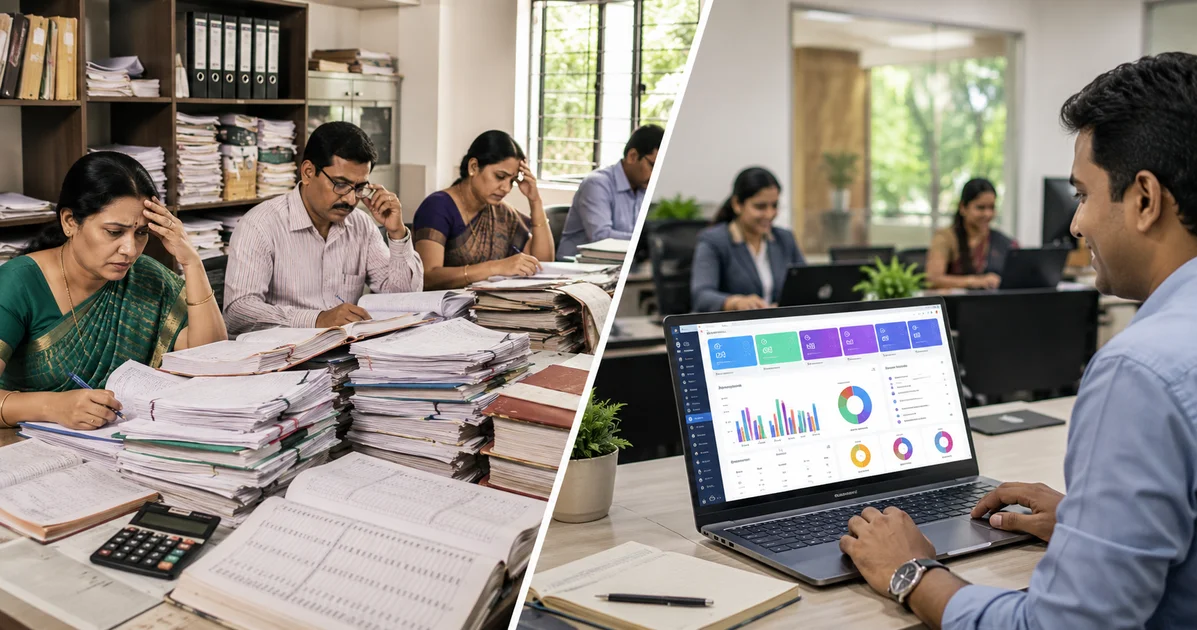
Top Challenges Schools Face Without School Management Software
Schools have to deal with a lot of people every day like students, teachers, parents and they have to do a lot of work to manage everything. Some schools still use ways of doing things like paper records, spreadsheets and traditional ways of talking to each other.