
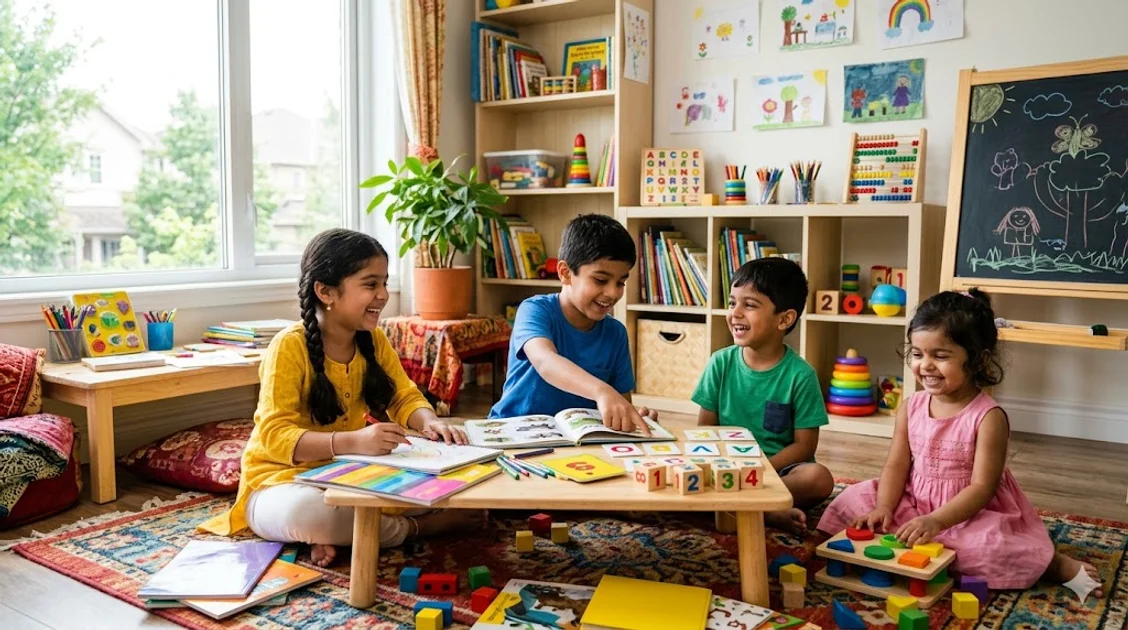
Best Learning Activities for Kids at Home for Kids who're 3 to 8 Years Old
Esha
Education Technology Experts
Best Learning Activities for Kids at Home (Age 3–8)
By Esha Karmakar
Teaching kids at home can be both fun and challenging. Children aged 3 to 8 learn best through activities that are interactive and enjoyable.
Instead of only studying from books, parents can use creative methods to help kids develop important skills like reading, writing, problem-solving, and creativity. Building consistency early also helps, as explained in how students can stay consistent in studies.
1. Reading Storybooks Together
Reading storybooks is one of the best ways to improve a child’s language skills.
- Choose colorful and simple books
- Read together daily
- Ask questions about the story
This improves vocabulary, imagination, and understanding.
2. Drawing and Coloring Activities
Drawing and coloring help children express creativity.
- Use crayons, sketch pens, or paints
- Encourage free drawing
- Give simple themes like animals or nature
This improves creativity and motor skills.
3. Educational Games for Kids
Games make learning fun and interactive.
- Puzzle games
- Alphabet and number games
- Memory games
These activities improve thinking and problem-solving skills.
4. Learning with Flashcards
Flashcards are great for quick learning.
- Alphabet flashcards
- Number flashcards
- Picture flashcards
They help children recognize and remember concepts easily.
5. Counting Objects is Fun
Math can be taught using everyday objects.
- Count fruits, toys, or steps
- Practice simple addition and subtraction
This makes learning math simple and practical.
6. Storytelling and Role Play Activities
Kids love imagination-based activities.
- Tell a story and ask kids to continue it
- Do role play like teacher-student or shopkeeper
This improves communication skills and confidence, which are part of essential life skills discussed in why soft skills matter more than marks.
7. Simple Science Activities for Kids
Basic experiments make children curious.
- Mix colors
- Test floating and sinking objects
- Plant seeds and observe growth
These activities build curiosity and interest in learning.
8. Learning from Daily Routine
Daily activities can also be great learning opportunities.
- Teach time using a clock
- Assign small responsibilities
- Encourage cleaning habits
This helps children learn important life skills.
9. Using Digital Learning Tools
Technology can support learning when used properly.
- Watch educational videos
- Use learning apps
- Play interactive games
This makes learning modern and engaging.
Conclusion
Learning at home does not have to be boring. With the right activities, kids can enjoy the process and learn better.
Parents should focus on making learning fun, creative, and consistent so children develop strong skills from an early age.
When learning becomes enjoyable, children grow more confident, curious, and ready for the future.
About the Author
Education Technology Experts
The Brilliyo editorial team shares insights on educational technology, learning management, and institution growth.
Related Articles

India Shut 94,000 Government Schools in a Decade — And the Children Who Paid the Price
That is not a statistic that is easy to sit with. Every single day for the past ten years, somewhere in India, a government school closed its gates — permanently. The building may still stand. The classrooms may still exist. But the school, as a functioning institution that children could walk to in the morning and walk home from in the afternoon, is gone.

CBSE Is Teaching AI to Children from Class 3 — And It Is Changing Everything
I remember when I was eight years old. In classrooms the newest gadget was a calculator if you were lucky. The thought that a primary school child could spend a class learning how AI thinks makes decisions and changes the world would have felt like science fiction.

Vidya Samiksha Kendra 2026 — How Data Is Finally Fixing India's Government Schools
For years the government school system in India has worked in a way that was hard to understand. Teachers were often not there. There was no good way to track that. Students started falling and by the time anyone noticed it was usually too late. Shown in exam results months later. Schools often didn't have textbooks and important information sat in a book that no one ever looked at.