
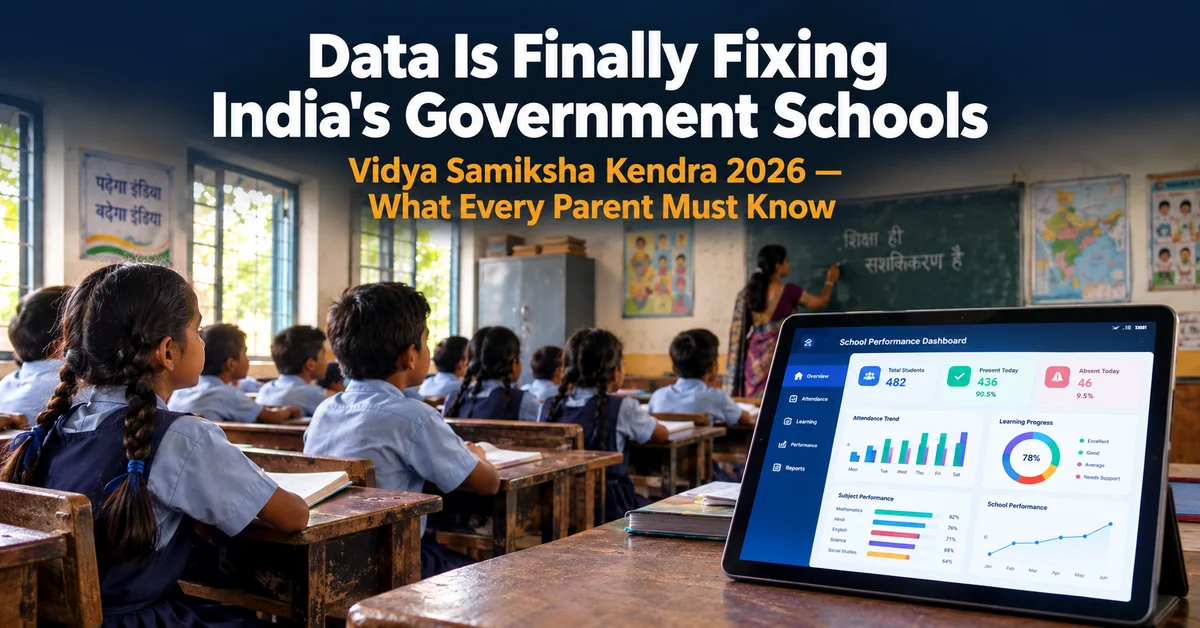
Vidya Samiksha Kendra 2026 — How Data Is Finally Fixing India's Government Schools
Gaurav Sharma
Blog content executive
For years the government school system in India has worked in a way that was hard to understand. Teachers were often absent and there was no good way to track that. Students started falling behind and by the time anyone noticed it was usually too late — shown in exam results months later. Schools often did not have textbooks and important information sat in a register that no one ever looked at.
In 2026 things are finally starting to change. And the thing driving that change is not a new curriculum, a new textbook or a new government scheme. It is data.
Vidya Samiksha Kendras are getting significant attention in school education. How data-driven monitoring can help improve learning outcomes across government schools is now one of the most actively discussed topics in Indian education policy. What is happening with these Kendras, why it matters and what it could mean for the millions of children in government schools is a story that every parent, educator and policymaker in India needs to understand.
What Is a Vidya Samiksha Kendra
A Vidya Samiksha Kendra — which translates roughly as an Education Review Centre — is a state-level command and control centre for school education. Think of it as a real-time dashboard for an entire state's school system.
Using data collected from schools across a state — attendance records, learning assessment results, infrastructure status, mid-day meal data, teacher deployment information and more — a Vidya Samiksha Kendra gives education officials a live picture of what is actually happening in schools across thousands of villages, towns and cities simultaneously.
The idea is simple and powerful. You cannot fix what you cannot see. And for decades India could not see its school system clearly enough to fix it.
The National Education Policy 2020 emphasized the need for these kinds of data-driven monitoring systems. Several states have now set up their own Vidya Samiksha Kendras — and where they have been implemented seriously the results are beginning to show.
Why India's Government Schools Needed This
India has over one million government schools serving hundreds of millions of children — the majority of them from lower-income families with no alternative if the government school fails them. For these children a failing school is not an inconvenience. It is a life-altering disadvantage.
A parliamentary panel has flagged a drastic decline of nearly 73 percent in student enrolment as education level progresses from primary to higher education — one of the starkest indicators of how badly the system is losing students along the way. Children enrol in primary school. Then they drop out. By the time higher education begins almost three quarters of the original students are gone.
The reasons are complex — poverty, child labour, early marriage, distance from schools. But a significant part of the dropout problem is simply that schools are not engaging students effectively. Teachers are absent. Learning quality is poor. Nobody notices until the child stops coming entirely.
A Vidya Samiksha Kendra is designed to catch these problems before they become permanent losses.
🔗 Poor school quality does not just cause dropouts — it quietly kills something deeper in children too. Read more: Why Indian Schools Are Finally Ditching Report Cards — And What Is Replacing Them
What Data-Driven Monitoring Actually Does
The power of a Vidya Samiksha Kendra lies in what happens when data is collected, analysed and acted upon in real time rather than buried in annual reports.
Teacher attendance can be tracked digitally. When a teacher is absent repeatedly from a specific school the Kendra flags it. An official can follow up within days rather than months. The accountability is immediate rather than eventual.
Student learning levels are assessed through periodic tests. When a school shows consistently low scores in foundational reading or mathematics the Kendra identifies it as needing support. A remedial intervention can be deployed specifically to that school rather than spread thinly across an entire district.
Infrastructure gaps — broken toilets, missing textbooks, non-functional drinking water — are reported through the system. When a school reports the same problem repeatedly without resolution the Kendra escalates it through the chain of command.
Dropout early warning systems can identify when attendance at a particular school begins falling — school by school, class by class — before the student officially drops out. An outreach worker can visit the family before the child is lost entirely.
This is the difference between a system that reacts to failure and a system that prevents it.
What States Are Doing With VSKs
Gujarat was among the first states to implement a Vidya Samiksha Kendra at scale and the results attracted national attention. Real-time monitoring of teacher attendance and student learning levels across thousands of schools showed improvements in both metrics after systematic follow-up began.
Several other states including Andhra Pradesh, Rajasthan and Himachal Pradesh have since established their own versions of the Kendra model with varying degrees of sophistication and implementation quality.
The Teach For India initiative has joined the Shikshagraha Movement to support one million public schools with a focus on better education quality and school infrastructure — signaling that civil society is also aligning behind the data-driven improvement of government schools.
The challenge across states has been consistent — collecting data is the easy part. Using it to drive real accountability and real change is where most systems struggle.
The Challenges That Remain
Vidya Samiksha Kendras are not a magic solution. Several serious challenges stand between the promise of these systems and the reality of improved outcomes for children.
Data quality is the first problem. A monitoring system is only as good as the data it receives. If schools report inflated attendance figures, exaggerated learning outcomes or incomplete information the dashboard shows a false picture. Building a culture of honest reporting in a system that has historically rewarded compliance over accuracy is a cultural change as much as a technological one.
Action on data is the second problem. Having a dashboard that shows which schools are struggling is valuable only if someone acts on it. Many state education systems lack the administrative capacity, the political will or the trained personnel to convert data insights into on-the-ground interventions at the speed and scale needed.
Teacher morale is the third concern. Monitoring systems that feel like surveillance rather than support can damage the relationship between teachers and the education system. The most effective VSK implementations are ones where teachers see the data being used to get them resources and support — not just to punish them for absences.
🔗 India's best students are already being given opportunities to go far beyond the classroom. Read more: Vikram Sarabhai Space Quiz 2026 — Everything Indian Students Need to Know
Conclusion
The Vidya Samiksha Kendra model represents something genuinely new in Indian education — a shift from managing schools by assumption to managing them by evidence. For a country with over a million government schools and hundreds of millions of students depending on them that shift is not incremental. It is fundamental.
The 73 percent dropout rate flagged by the parliamentary panel is not inevitable. It is a symptom of a system that has not been able to see itself clearly enough to intervene effectively. Vidya Samiksha Kendras are one of the most promising tools India has developed to change that.
Whether they fulfil their potential will depend on political commitment, administrative capacity and the willingness to use data not just to monitor schools but to genuinely improve them. The technology is ready. The question — as always in Indian education — is whether the will to use it honestly and consistently is ready too.
Frequently Asked Questions
What is a Vidya Samiksha Kendra?
A Vidya Samiksha Kendra is a state-level data monitoring centre for school education. It collects and analyses real-time information on teacher attendance, student learning levels, school infrastructure and other key metrics to help education officials identify and address problems in government schools quickly and effectively.
Which states in India have Vidya Samiksha Kendras?
Gujarat was among the first states to implement the Vidya Samiksha Kendra model at scale. Several other states including Andhra Pradesh, Rajasthan and Himachal Pradesh have since established their own versions. NEP 2020 has encouraged all states to develop similar data monitoring systems.
How does Vidya Samiksha Kendra improve school education?
By providing real-time data on teacher attendance, student performance and infrastructure status VSKs allow education officials to identify struggling schools quickly, deploy targeted interventions and track whether improvements are actually happening — rather than waiting for annual reports.
What is the student dropout problem in Indian government schools?
A parliamentary panel recently flagged that student enrolment drops by nearly 73 percent as students progress from primary to higher education — meaning that for every 100 children who start primary school fewer than 30 reach higher education. Improving school quality and early dropout detection are key goals of the VSK model.
What is NEP 2020's role in Vidya Samiksha Kendras?
The National Education Policy 2020 explicitly emphasized the need for data-driven monitoring of school education and called for the establishment of state-level review systems. Vidya Samiksha Kendras are one of the primary mechanisms through which states are implementing this NEP 2020 vision.
About the Author
Blog content executive
Creative and detail-oriented Blog Content Executive skilled in creating engaging, informative, and SEO-friendly blog content. Experienced in content research, keyword integration, blog planning, editing, and maintaining consistent brand tone. Passionate about creating valuable content that attracts readers, improves engagement, and supports website growth.
Related Articles
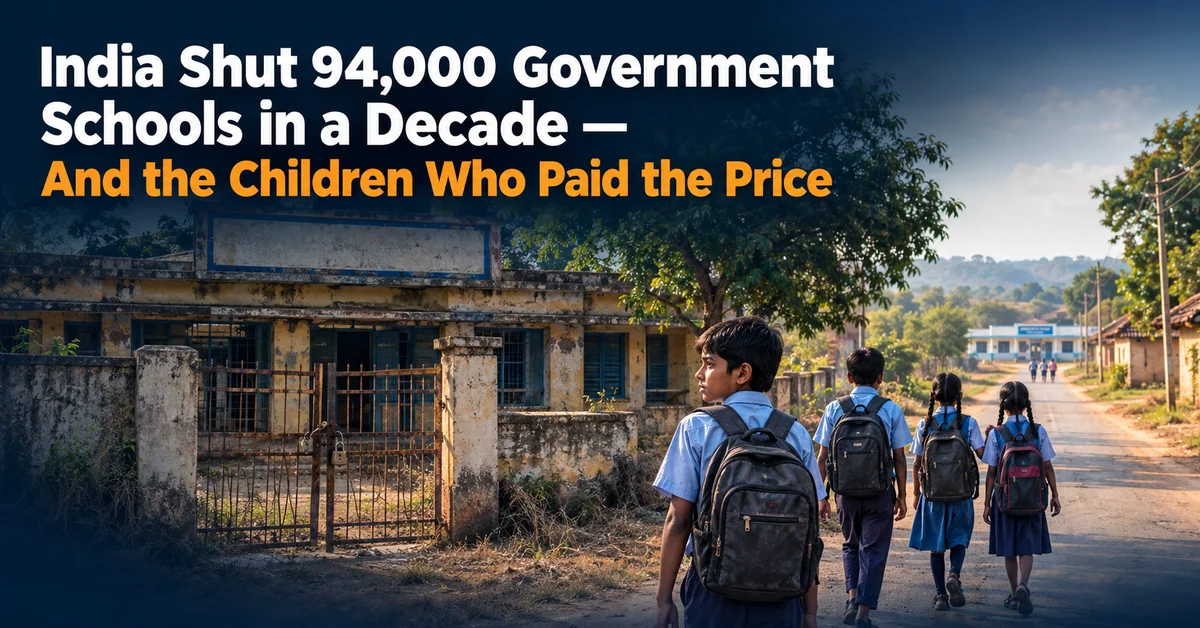
India Shut 94,000 Government Schools in a Decade — And the Children Who Paid the Price
That is not a statistic that is easy to sit with. Every single day for the past ten years, somewhere in India, a government school closed its gates — permanently. The building may still stand. The classrooms may still exist. But the school, as a functioning institution that children could walk to in the morning and walk home from in the afternoon, is gone.
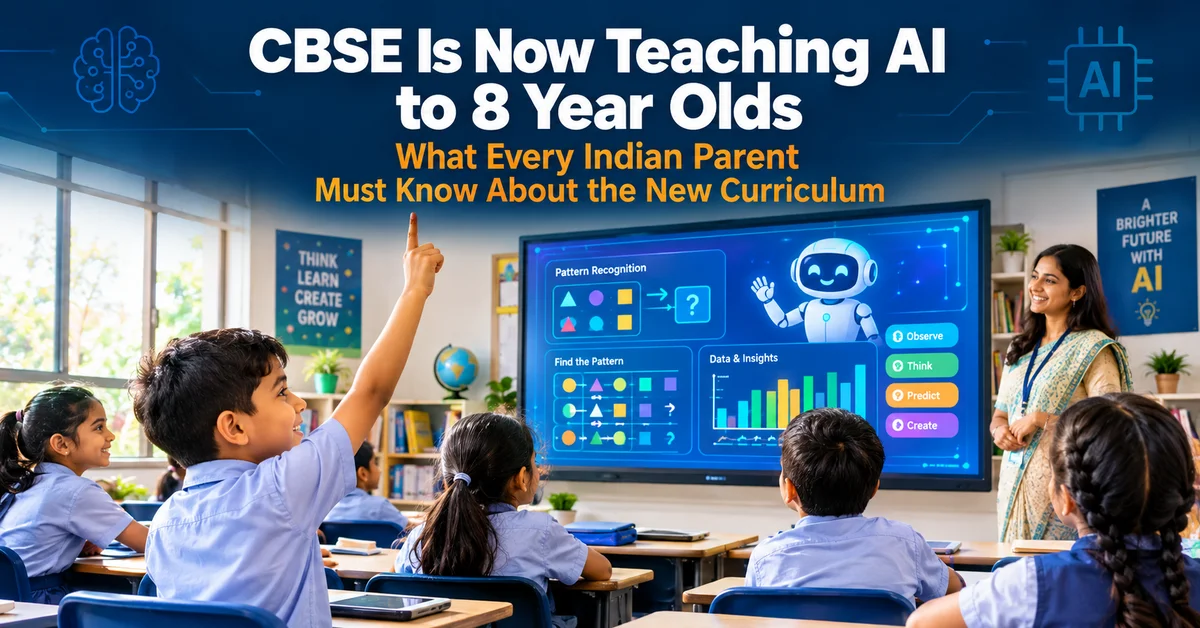
CBSE Is Teaching AI to Children from Class 3 — And It Is Changing Everything
I remember when I was eight years old. In classrooms the newest gadget was a calculator if you were lucky. The thought that a primary school child could spend a class learning how AI thinks makes decisions and changes the world would have felt like science fiction.
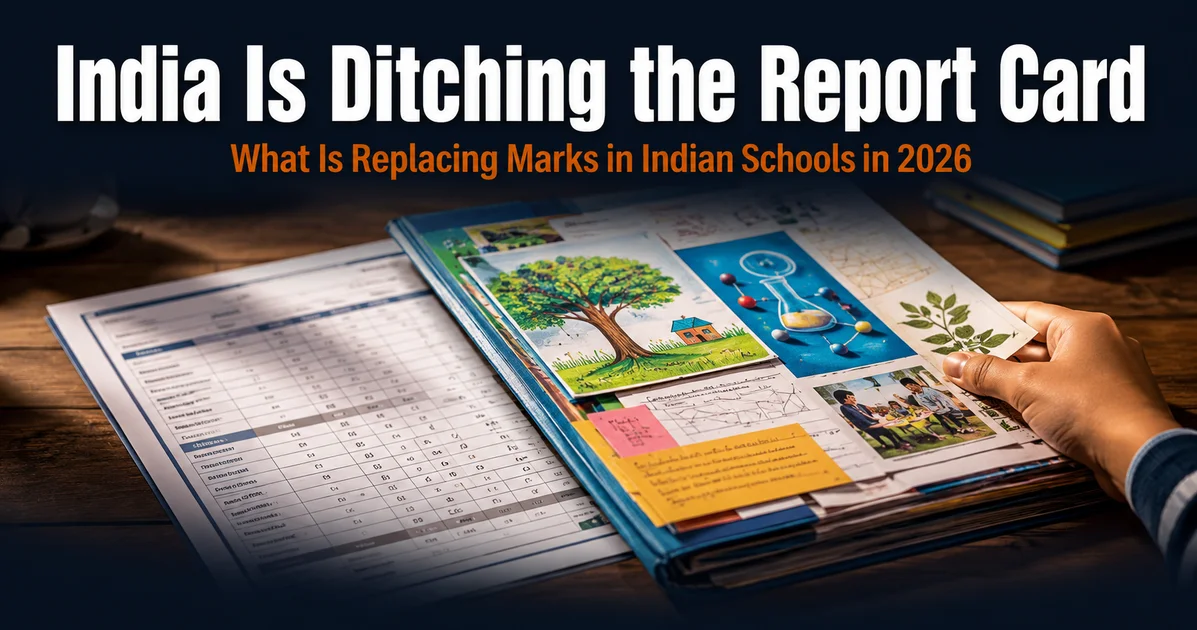
Why Indian Schools Are Finally Ditching Report Cards — And What Is Replacing Them
For generations the report card has been the important piece of paper in an Indian childs life. It comes twice a year. Parents wait for it with a mix of hope and worry. Children bring it home knowing that their worth in the eyes of school teachers and sometimes family has been cut down to a row of numbers. In 2026 that is beginning to change. The change is larger, more permanent and more meaningful than most parents and teachers in India realize.