
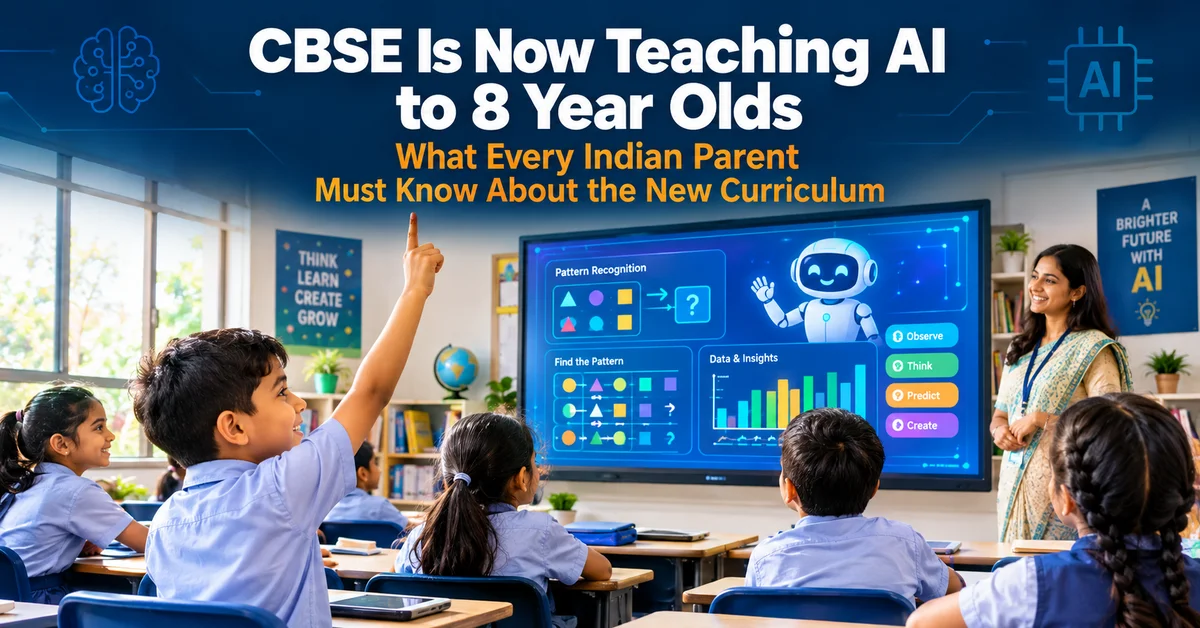
CBSE Is Teaching AI to Children from Class 3 — And It Is Changing Everything

Esha
Content Writer & Education Technology Researcher
I remember when I was eight years old. In classrooms the newest gadget was a calculator — if you were lucky. The thought that a primary school child could spend a class learning how AI thinks, makes decisions and changes the world would have felt like science fiction.
By 2026 it is the new normal for CBSE students.
The Central Board of Secondary Education has launched an AI curriculum for students in Classes 3 to 8 — making India one of the very few countries in the world to formally embed artificial intelligence learning into primary and middle school classrooms. This is not a pilot programme or a special course for gifted students. It is a board-level curriculum that will reach millions of Indian children across thousands of schools.
This decision will shape how an entire generation thinks about technology, problem-solving and the future. And most Indian parents have barely heard about it.
What the CBSE AI Curriculum Actually Covers
The CBSE AI curriculum for Classes 3 to 8 is not about teaching children to code complex algorithms or build machine learning models. It is designed to be age-appropriate, practical and focused on building foundational AI literacy — the ability to understand, question and work alongside artificial intelligence rather than simply being controlled by it.
For students in Classes 3 and 4 the curriculum introduces basic concepts through stories, games and activities. Children learn what a pattern is, how computers recognise patterns and how machines can be trained to make simple decisions. The emphasis is on thinking skills — observation, classification and prediction — that underpin both human intelligence and artificial intelligence.
For students in Classes 5 and 6 the curriculum builds on these foundations with introductions to data — what it is, how it is collected, how it can be used and misused. Students begin to understand that the recommendations they see on YouTube or the search results that appear on Google are not random. They are the result of algorithms trained on data that includes their own behaviour.
By Classes 7 and 8 students are engaging with more complex ideas — how AI systems are trained, what bias in AI means and why it matters, how facial recognition works and what ethical questions arise when machines make decisions that affect people's lives. These are not simple topics. But they are exactly the topics that every young person growing up in 2026 needs to understand.
Why This Matters More Than Most People Realize
India's decision to introduce AI education from Class 3 is significant for reasons that go far beyond technology skills.
The children who understand how AI works will not be controlled by it. They will know why their social media feed shows them what it shows. They will understand when an AI recommendation is in their interest and when it is designed to serve someone else's interest. They will be equipped to question automated decisions rather than simply accept them.
This is not a small thing. In a world where AI systems are increasingly making decisions about who gets a loan, who gets shortlisted for a job, which students get flagged for support and which neighbourhoods receive police attention — the ability to understand and question these systems is a fundamental democratic skill.
An AI-literate generation is a generation that can hold power to account in the digital age. And India is now building that generation from the age of eight.
🔗 India is also transforming how it monitors and improves its schools using data. Read more: Vidya Samiksha Kendra 2026 — How Data Is Finally Fixing India's Government Schools
What This Means for Indian Schools and Teachers
Introducing a new curriculum is one thing. Implementing it effectively across thousands of schools with teachers who were never trained in AI is quite another.
The success of the CBSE AI curriculum will depend enormously on teacher preparation. A teacher who does not understand what artificial intelligence is cannot meaningfully teach it — regardless of what the syllabus says. This means teacher training programmes need to move quickly and at scale.
CBSE has been stepping up regional events and teacher capacity-building programmes ahead of new academic initiatives. The CBSE Skill Expo and Guidance Festival 2026-27 is one example of this effort. But the gap between curriculum launch and effective classroom implementation is always significant in the Indian context — and AI is a particularly challenging subject for teachers who have not grown up with it.
Schools that take this seriously — investing in teacher training, accessing the digital tools needed to make AI education practical and hands-on, and creating space in the timetable for exploratory learning — will give their students a genuine advantage. Schools that treat AI as another subject to be memorised and tested will miss the point entirely.
What Parents Should Know and Do
If your child is in Classes 3 to 8 at a CBSE school the AI curriculum is now part of their education. Here is what parents need to know.
This is not about screens and gadgets. The goal of AI education at this level is to develop thinking skills — the ability to observe patterns, ask critical questions about information, understand how systems work and think about the ethical implications of technology. These skills will serve your child in every area of life, not just in technology careers.
Talk to your child about AI at home. When your child watches a recommendation appear on a streaming platform ask them why they think that recommendation appeared. When a navigation app suggests a route ask them how they think the app decided on that route. These everyday conversations reinforce what the curriculum is trying to build.
Ask your school how they are implementing the AI curriculum. Not all schools are doing this equally well. A school that has invested in teacher training and practical AI activities is giving your child something genuinely valuable. A school that is treating AI as a textbook chapter to be memorised is not.
🔗 How schools assess and communicate student progress is also changing rapidly across India. Read more: Why Indian Schools Are Finally Ditching Report Cards — And What Is Replacing Them
India's Bigger Picture — AI Literacy as a National Priority
India's decision to introduce AI curriculum from Class 3 is part of a broader national conversation about preparing the country for an AI-powered future.
The government's vision for Viksit Bharat 2047 — a fully developed India by the centenary of independence — depends significantly on India's ability to produce not just AI users but AI creators, AI critics and AI policymakers. A nation of people who understand artificial intelligence deeply is far better equipped to shape how it develops than a nation of people who simply use the products that others build.
By starting AI education at age eight India is giving its children a head start that could take decades to close for countries that begin this journey later. The children sitting in CBSE classrooms learning about patterns and algorithms today are the people who will be designing India's AI policy, building India's AI companies and deciding how AI affects Indian society in 2047.
That is not an exaggeration. It is simply what happens when you teach an entire generation something that matters.
Conclusion
The introduction of an AI curriculum for Classes 3 to 8 by CBSE is one of the most forward-looking decisions Indian education has made in years. It is not perfect — implementation will be uneven, teacher training will lag and some schools will reduce it to a memorisation exercise. But the direction is right and the scale is extraordinary.
India is telling its eight year olds that artificial intelligence is not something that happens to them. It is something they can understand, question and one day shape.
That is a message worth building an entire curriculum around. And it is a message that could change what India looks like in twenty years.
Frequently Asked Questions
What is the CBSE AI curriculum for Classes 3 to 8?
CBSE has launched an artificial intelligence curriculum for students in Classes 3 to 8 as part of its 2026-27 academic initiatives. The curriculum introduces AI concepts including pattern recognition, data literacy, how algorithms work and the ethical questions that come with AI — building foundational AI literacy across primary and middle school students.
Why is CBSE introducing AI from Class 3?
Starting AI education early gives students the foundational thinking skills — recognising patterns, asking critical questions and understanding data — that underpin both human and artificial intelligence. It also ensures that children grow up understanding the technology that will shape their lives rather than simply being affected by it.
What will Class 3 students learn about AI?
Class 3 students will be introduced to AI ideas through stories, games and activities focused on patterns, observation, classification and prediction — the core thinking skills that connect human learning to how machines learn.
Do teachers need special training to teach the AI curriculum?
Yes. Effective implementation requires teachers who understand the subject. CBSE is running capacity-building programmes through initiatives like the CBSE Skill Expo and Guidance Festival 2026-27 but getting enough teachers ready at scale remains one of the biggest challenges for the successful rollout of this curriculum.
How does AI education benefit Indian students in the long term?
AI literacy gives students the ability to understand, question and work alongside AI systems rather than simply being affected by them. As AI increasingly influences decisions in education, employment, finance and public services — understanding how these systems work is a fundamental skill for informed citizenship and career readiness in the 21st century.
About the Author

Content Writer & Education Technology Researcher
Esha is a Content Writer specializing in EdTech, School ERP, Learning Management Systems (LMS), AI in Education, and digital learning. She creates SEO-focused educational content that helps schools and institutions embrace modern technology.
Related Articles
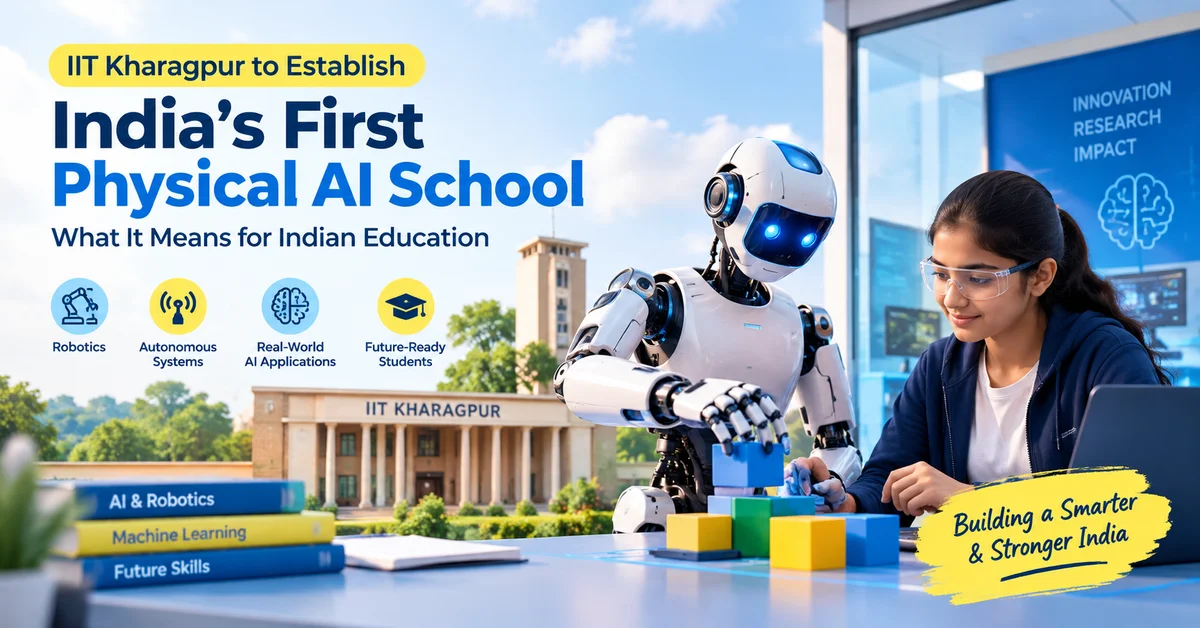
India’s First Physical AI School Is Coming — And It Changes Everything About How We Think About Education
There is a version of artificial intelligence that most people are familiar with by now. It lives on screens. It answers questions, generates text, recommends content and makes decisions in the background of digital systems. It is impressive, it is useful and it is already reshaping how India’s schools and universities are thinking about education.
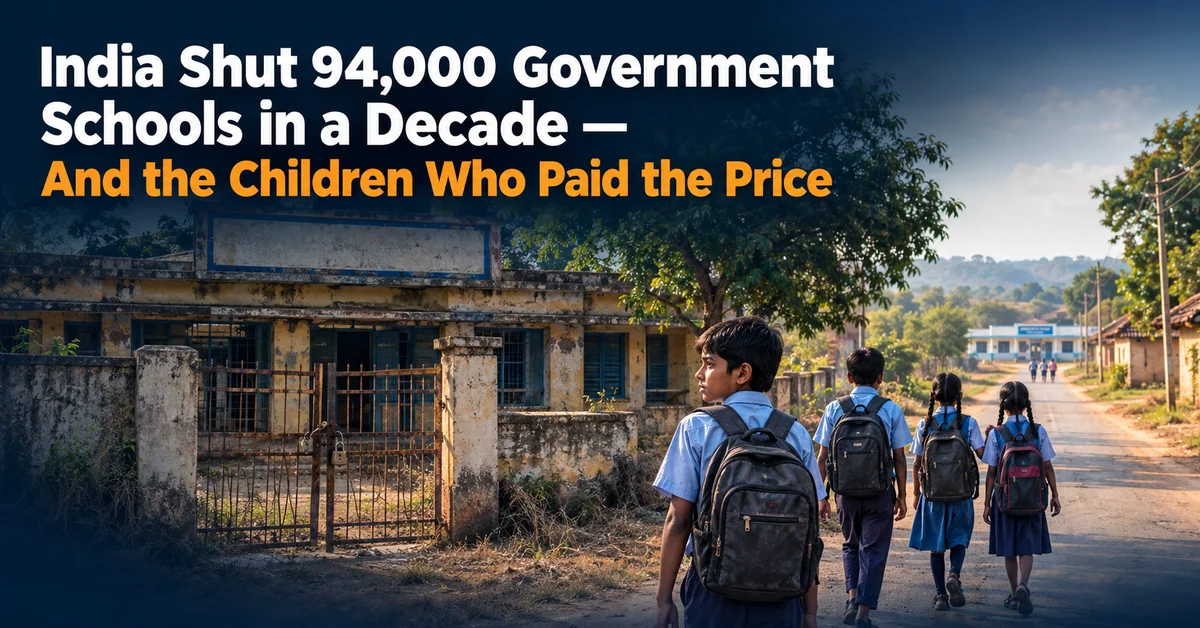
India Shut 94,000 Government Schools in a Decade — And the Children Who Paid the Price
That is not a statistic that is easy to sit with. Every single day for the past ten years, somewhere in India, a government school closed its gates — permanently. The building may still stand. The classrooms may still exist. But the school, as a functioning institution that children could walk to in the morning and walk home from in the afternoon, is gone.
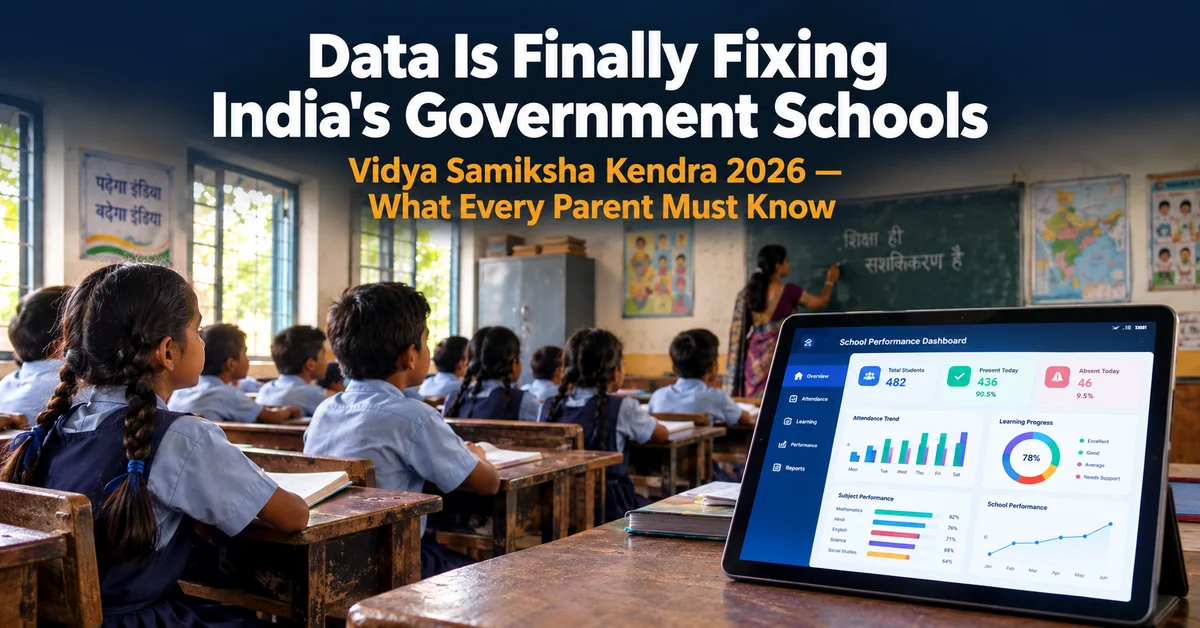
Vidya Samiksha Kendra 2026 — How Data Is Finally Fixing India's Government Schools
For years the government school system in India has worked in a way that was hard to understand. Teachers were often not there. There was no good way to track that. Students started falling and by the time anyone noticed it was usually too late. Shown in exam results months later. Schools often didn't have textbooks and important information sat in a book that no one ever looked at.