
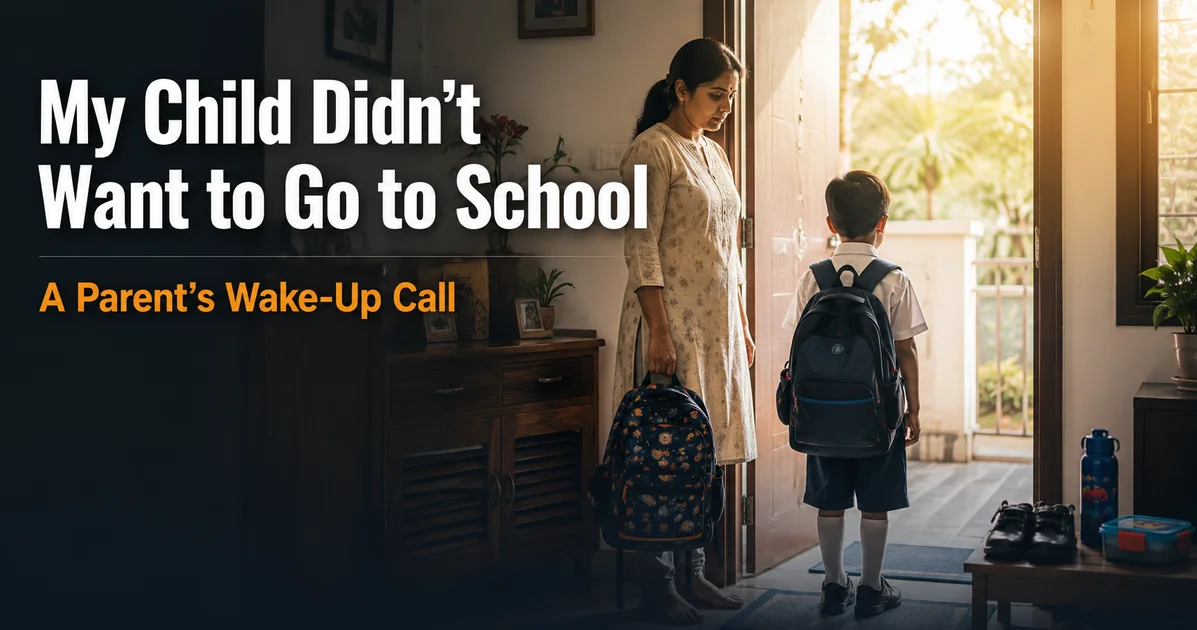
The Day My Child Cried Before School Every Morning — What I Did Wrong as a Parent

Brilliyo Editorial Team
Education Technology Experts
I remember the morning it started.
My daughter was seven years old. She woke up, came to the kitchen for breakfast, saw her school bag by the door — and started crying. It was not a little cry. It was the kind of crying that comes from somewhere deep inside. The kind that makes a parent feel something that does not go away quickly.
I did what I thought was right. I told her everything was okay. I said school was important and her friends were there. I gave her a biscuit, wiped her face and put her in the car.
She cried all the way to school.
This happened every single morning for three months. And in those three months I made almost every mistake a parent can make.
My First Mistake — I Did Not Take Her Feelings Seriously
The morning crying was hard for me to deal with. I was worried. I was also impatient. We had a schedule to keep. So I told her she was fine, there was nothing to be scared of, to stop crying and get ready.
I said these things because I loved her. What I did not understand was that telling a child their feelings are not valid does not make the feelings go away. It just teaches the child that their feelings are not safe to share with you.
My daughter stopped telling me she was scared. She just cried quietly in the car instead. I thought she was getting better. She was just getting quieter. Those are two very different things.
My Second Mistake — I Made It About Me
After a few weeks I started to feel embarrassed. Other children walked into school without drama. Other parents dropped their children and left. My daughter clung to my hand, red-eyed and trembling, while I tried to peel her fingers away without making a scene.
I started thinking about what teachers and other parents were thinking. And so without realizing it I shifted the focus from what my daughter needed to how the situation looked.
I rushed the goodbye. I used a firmer voice. I told her she was making things harder than they needed to be.
She was seven years old and frightened. She needed patience. I gave her performance.
My Third Mistake — I Looked for a Quick Fix
When the crying did not stop I went online looking for solutions. Morning routine tips. Distraction techniques. Reward charts for brave mornings. Some worked for a day or two. Nothing worked for long.
I was treating the symptom — the morning crying — without understanding the cause.
What I did not know then was that school anxiety in children is almost never really about school. It is usually about something underneath — a fear of separation, a social difficulty, something that happened in the classroom that the child does not have the words to explain yet.
My daughter was not crying because she hated school. She was crying because she felt something she could not name — and I was not sitting still long enough to help her find the words.
🔗 Academic pressure and social struggles affect Indian children in more ways than most parents realize. Read more: The Student Who Tops Every Exam But Cannot Make a Single Friend — India's Hidden Crisis
The Morning Everything Changed
Three months in, on a Tuesday morning, I did something different.
Instead of rushing, I sat down on the kitchen floor next to her school bag. I did not say anything about school or time or being brave. I just sat with her while she cried. When the crying slowed down I asked her one question.
"What is the part that feels the worst?"
She thought about it for a long time. Then she said:
"I do not know if anyone will sit with me at lunch."
That was it. That was the whole thing. Three months of morning tears came down to one small, specific, heartbreaking fear — that she would sit alone at a lunch table and nobody would come.
I had been solving the wrong problem entirely.
What I Did Differently After That Morning
Once I understood what was actually frightening her everything changed — not overnight, but gradually and genuinely.
I spoke to her class teacher — not to complain but to share what my daughter had told me. The teacher quietly arranged for my daughter to be paired with a kind classmate during lunch for a few weeks. Nothing dramatic. Nobody made an announcement. It just happened.
At home I started asking about her day differently. Instead of "how was school" I asked "what was the best part of lunch today" or "did anything make you laugh." Specific questions got specific answers. Slowly the answers started to include names. Friends. Stories.
I also stopped making the school gate goodbye a performance. I gave her a hug, told her I would be there at pickup and left. The shorter and calmer the goodbye the easier it became. Every parent of an anxious child eventually learns this — but most of us learn it later than we should.
What I Wish I Had Known Earlier
School anxiety in children is far more common than most parents realize. It is not a sign of a weak child or bad parenting. It is often a sign of a sensitive child who is picking up on something real in their environment that adults have not yet noticed.
The fastest way to make school anxiety worse is to dismiss it or rush past it. The fastest way to make it better is to get genuinely curious about it — to sit with your child in the feeling and ask questions until you find the specific real thing underneath.
And most importantly — your child's feelings about school are information. They are telling you something. Your job as a parent is not to silence that information but to listen carefully enough to understand what it is actually saying.
🔗 The pressure Indian families put on their children's education often has a deeper cost than most people see. Read more: Why Indian Parents Are Taking Loans to Pay School Fees — And Regretting It
Conclusion
My daughter is twelve now. She walks into school with her friends, laughing about something I will never fully understand, and does not look back. The girl who cried every morning for three months is still in there somewhere — she is just not frightened anymore.
I did not help her get over school anxiety by being firmer or smarter or finding the right reward chart. I helped her by finally stopping, sitting down and asking the right question.
To every parent standing at the school gate right now with a crying child — feeling helpless, embarrassed and frustrated — what you are going through is real, it is hard and it happens to far more families than you know.
Slow down. Sit down. Ask the question. Listen to the answer.
Your child is not trying to make your morning difficult. They are trying to tell you something. They need you to be still enough to hear it.
Frequently Asked Questions
Why do some children cry before school every morning?
School anxiety is usually caused by an underlying fear — separation anxiety, difficulty making friends or something specific happening in the classroom that the child cannot yet put into words. The morning crying is a symptom. The real cause is almost always something more specific underneath.
Is school anxiety normal in young children?
Yes. School anxiety is very common, especially between the ages of five and ten. It does not mean something is seriously wrong. It usually means a child is feeling something they cannot fully express yet and needs help identifying the specific fear.
What is the worst thing a parent can do when their child cries before school?
Minimizing the child's feelings, rushing the goodbye and making it about your own embarrassment are the most common and damaging mistakes. These responses teach the child that their feelings are not safe to share — which makes the anxiety harder to address, not easier.
How long does school anxiety usually last?
With the right support school anxiety usually improves significantly within a few weeks to a few months. Without understanding the underlying cause it can persist much longer and sometimes get worse over time.
When should a parent seek professional help for school anxiety?
If the anxiety is severe, has lasted more than a few months, is affecting your child's sleep or eating, or is beginning to impact academic performance — speaking with a school counselor or child psychologist is a healthy and important step.
About the Author

Education Technology Experts
The Brilliyo editorial team shares insights on educational technology, learning management, and institution growth.
Related Articles

India Shut 94,000 Government Schools in a Decade — And the Children Who Paid the Price
That is not a statistic that is easy to sit with. Every single day for the past ten years, somewhere in India, a government school closed its gates — permanently. The building may still stand. The classrooms may still exist. But the school, as a functioning institution that children could walk to in the morning and walk home from in the afternoon, is gone.

CBSE Is Teaching AI to Children from Class 3 — And It Is Changing Everything
I remember when I was eight years old. In classrooms the newest gadget was a calculator if you were lucky. The thought that a primary school child could spend a class learning how AI thinks makes decisions and changes the world would have felt like science fiction.

Vidya Samiksha Kendra 2026 — How Data Is Finally Fixing India's Government Schools
For years the government school system in India has worked in a way that was hard to understand. Teachers were often not there. There was no good way to track that. Students started falling and by the time anyone noticed it was usually too late. Shown in exam results months later. Schools often didn't have textbooks and important information sat in a book that no one ever looked at.