
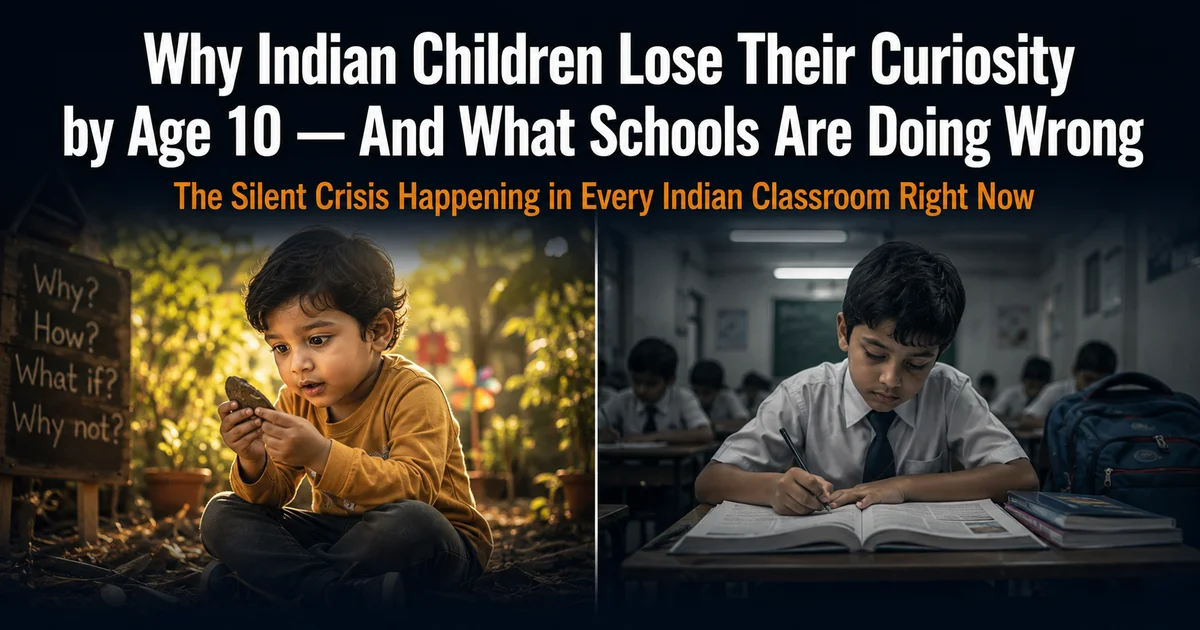
Why Indian Children Are Losing Their Curiosity by Age 10 — And What Schools Are Doing Wrong

Esha
Content Writer & Education Technology Researcher
Watch a three year old for ten minutes. They ask why the sky is blue. They want to know where ants go at night. They pick up a rock and turn it over forty times just to see what is underneath. They are relentlessly, beautifully curious.
Now watch a ten year old in an Indian school. They sit quietly. They copy what the teacher writes on the board. They answer only when called upon. They have learned — without anyone explicitly teaching them this — that asking too many questions is a problem.
Somewhere between age three and age ten Indian children stop asking why. And that loss is costing India more than most people realize.
1. Schools Are Rewarding Silence Not Questions
The Indian classroom has one unspoken rule that every child learns very quickly. The student who sits quietly and gives correct answers is a good student. The student who asks unexpected questions is a disturbance.
This is not always intentional. Teachers managing forty students in a single classroom simply do not have the time or space to follow every curious thread a child pulls. So curiosity gets quietly managed out of children — not through punishment but through the steady daily experience of questions being brushed aside, redirected or simply not welcomed.
A child who asks "why" six times and gets no real answer learns to stop asking. Not because they are no longer curious — but because they have learned that their curiosity does not matter here. And that is one of the saddest things a child can learn in school.
2. The Curriculum Leaves No Room for Wonder
India's school curriculum is one of the most content-heavy in the world. There is simply no time built into the school day for a child to wonder, explore or follow a question that is not on the syllabus.
Every minute of every class is accounted for. Topics must be covered. Portions must be completed. Exams must be prepared for. In this environment curiosity is not just unwelcome — it is structurally impossible. A teacher who pauses to explore a student's unexpected question about black holes during a geography lesson is falling behind on the portion.
The curriculum is designed to deliver answers. It is not designed to generate questions. And a child who spends ten years in a system that only values answers eventually stops generating questions of their own.
🔗 India's schools are slowly recognizing this problem — and some are beginning to celebrate learning in more meaningful ways. Read more: 80th Independence Day 2026 — What Indian Schools Are Doing Differently This August 15
3. Marks Have Replaced Meaning
Ask most Indian students why they are studying a particular topic and the answer is almost always the same — "because it will come in the exam."
Not because it is fascinating. Not because understanding it will help them make sense of the world. Because it will come in the exam.
This is what happens when an entire education system is organized around a single outcome — marks. When marks are the only thing that matter, learning becomes about memorization rather than understanding. And memorization has no room for curiosity. You do not need to wonder why something is true if you only need to remember that it is.
The child who once spent an hour wondering how a caterpillar becomes a butterfly now spends that same hour memorizing the stages of metamorphosis in the exact words the textbook uses — because that is what the exam requires.
The wonder has been replaced by a word list.
4. Parents Are Accidentally Finishing the Job
Schools start the process of extinguishing curiosity. Parents often complete it without realizing.
When a child comes home excited about something they discovered — a question about space, a strange fact about animals, an idea that does not fit neatly into the textbook — the response they most commonly get from busy, stressed Indian parents is a version of the same message.
"That is nice. Now do your homework."
It is not said with cruelty. It is said with love and practicality. There are assignments to complete, exams to prepare for, sleep to get. But the cumulative effect of that response — repeated hundreds of times over years — is devastating to a child's natural curiosity.
The child learns that their sense of wonder is an interruption. That the questions that excite them are not as important as the answers that will be marked. And so they stop bringing their wonder home. They stop bringing it to school. And eventually — somewhere around age ten — they stop having it at all.
🔗 The financial pressure Indian families face in education is also quietly affecting how children experience school at home. Read more: Delhi Private School Fee Regulation 2026 — What Every Parent in India Must Know Right Now
Conclusion
Curiosity is not a personality trait that some children have and others do not. It is a natural human instinct that every child is born with — and that every child deserves to keep.
India cannot build the innovative, creative, problem-solving workforce it needs for 2047 by producing a generation of students who have been quietly taught to stop asking questions. The most important thing Indian schools and parents can do for a child's future is not to give them more answers. It is to protect their hunger for questions.
A child who never stops asking why will always find a way to figure out how.
Frequently Asked Questions
At what age do Indian children typically lose their curiosity?
Research and classroom observations suggest that the most significant drop in natural curiosity happens between ages eight and twelve — the years when academic pressure increases sharply and the reward system in schools shifts fully toward marks and correct answers.
Can lost curiosity be recovered in older students?
Yes — but it requires deliberate effort from both teachers and parents. Creating safe spaces for questions, celebrating wrong answers as part of learning and connecting subjects to real world relevance are all proven ways to reawaken curiosity in older students.
What can parents do to protect their child's curiosity?
The single most powerful thing a parent can do is take their child's questions seriously. Instead of redirecting to homework spend ten minutes exploring the question together. Look it up. Discuss it. Show your child that their curiosity is worth your time.
What should Indian schools do differently?
Schools should build unstructured exploration time into the school day, train teachers to welcome unexpected questions rather than manage them and design assessments that reward original thinking alongside content recall.
About the Author

Content Writer & Education Technology Researcher
Esha is a Content Writer specializing in EdTech, School ERP, Learning Management Systems (LMS), AI in Education, and digital learning. She creates SEO-focused educational content that helps schools and institutions embrace modern technology.
Related Articles
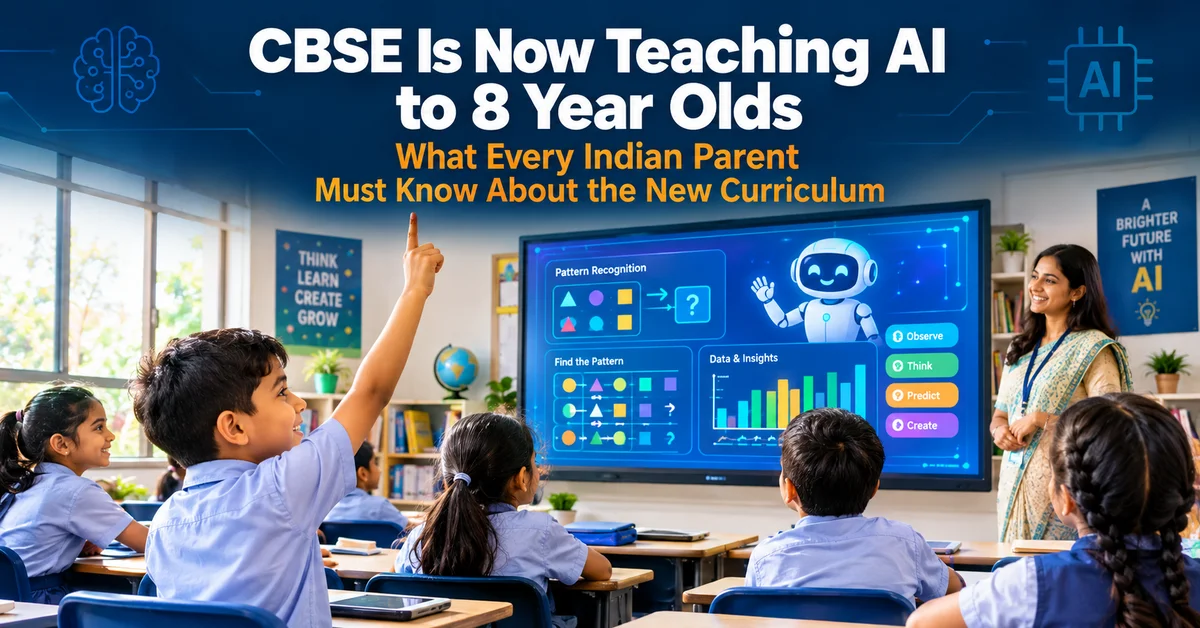
CBSE Is Teaching AI to Children from Class 3 — And It Is Changing Everything
I remember when I was eight years old. In classrooms the newest gadget was a calculator if you were lucky. The thought that a primary school child could spend a class learning how AI thinks makes decisions and changes the world would have felt like science fiction.

Vidya Samiksha Kendra 2026 — How Data Is Finally Fixing India's Government Schools
For years the government school system in India has worked in a way that was hard to understand. Teachers were often not there. There was no good way to track that. Students started falling and by the time anyone noticed it was usually too late. Shown in exam results months later. Schools often didn't have textbooks and important information sat in a book that no one ever looked at.

Why Indian Schools Are Finally Ditching Report Cards — And What Is Replacing Them
For generations the report card has been the important piece of paper in an Indian childs life. It comes twice a year. Parents wait for it with a mix of hope and worry. Children bring it home knowing that their worth in the eyes of school teachers and sometimes family has been cut down to a row of numbers. In 2026 that is beginning to change. The change is larger, more permanent and more meaningful than most parents and teachers in India realize.