
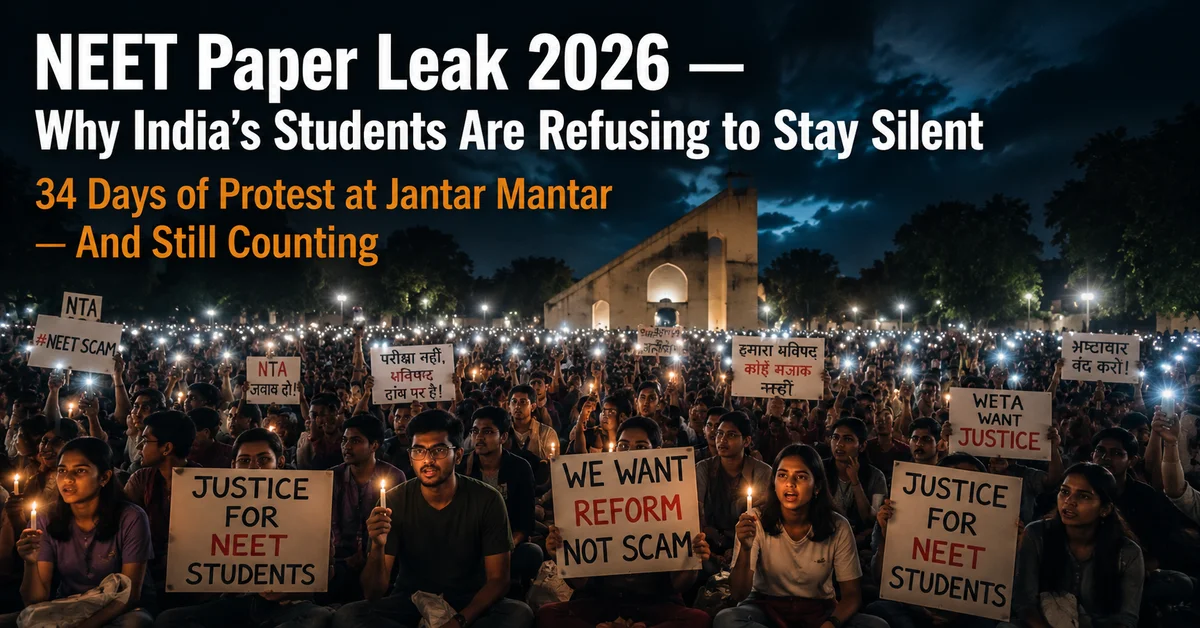
NEET Paper Leak 2026 — Why Thousands of Students Are Protesting at Jantar Mantar

Esha
Content Writer & Education Technology Researcher
Something has been burning at the heart of New Delhi for over 34 days now.
At Jantar Mantar in New Delhi thousands of students, activists and youth organisations have been gathered in protest — demanding accountability over the 2026 NEET paper leak and irregularities in CBSE's on-screen marking system. The protest has grown into one of the most significant student movements India has seen in years. And it is not showing any signs of stopping.
For the 22 lakh students who appeared for NEET-UG 2026 this is not a political issue. It is personal. It is years of sacrifice, sleepless nights, coaching fees and family pressure — all built around a single exam. That exam was compromised.
What Happened — The NEET Paper Leak 2026
Around 22 lakh candidates appeared for NEET-UG 2026. Allegations of a question paper leak surfaced soon after the examination was held on 3 May.
Days later the National Testing Agency cancelled the examination and the Centre handed the investigation to the Central Bureau of Investigation — triggering protests across the country.
For students who had spent two, three, sometimes four years preparing for this single examination the cancellation was devastating. But the anger went deeper than just the cancellation. It was about a system that allowed the leak to happen in the first place. A system that millions of students had trusted with their futures.
Who Is Protesting and What Are They Demanding
The protests were initiated on 6 June 2026 by the Cockroach Janta Party — an Indian youth-based satirical political movement — alongside student organisations including the Students Federation of India, All India Students Association and All India Students Federation.
The protesters have three core demands:
Resignation of Union Education Minister Dharmendra Pradhan
Complete reform of how public examinations are conducted in India
Accountability for those responsible for the paper leak
As student protests over the NEET paper leak showed no signs of stopping after 34 days, the government on July 23 restricted all mobile internet services within a 1.5-km radius of Jantar Mantar until midnight. Connaught Place shops and establishments were also ordered to shut by 6:30 pm — an extraordinary step that showed just how seriously the government was taking the scale of the protest.
🔗 The pressure India's education system puts on students goes far beyond one exam. Read more: Why Indian Parents Are Taking Loans to Pay School Fees — And Regretting It
Sonam Wangchuk's Hunger Strike — How It Changed Everything
The protest gained national and international attention when a familiar face arrived at Jantar Mantar.
Sonam Wangchuk — the engineer-turned-activist who inspired a character in the blockbuster Bollywood film 3 Idiots — began an indefinite hunger strike at the protest site on June 28 in solidarity with the Gen Z-led Cockroach Janta Party.
Wangchuk, a Ramon Magsaysay Award recipient, engineer, activist, innovator, education reformer and environmentalist, said he would end his hunger strike only if the Central Government gave an unequivocal assurance that no punitive or retaliatory legal action would be taken against students and protesters who participated in the movement.
Wangchuk ended his 26-day hunger strike after meeting Union Ministers J.P. Nadda and Jitendra Singh. The meeting opened a channel for dialogue between protest representatives and the Centre. Student groups however said demonstrations would continue until their demands were addressed.
What the Government Has Done So Far
The government has taken some steps in response to the crisis. Prime Minister Narendra Modi announced fast-track courts for paper leak cases, a proposal for tougher anti-paper leak legislation and strict action against officials found guilty of negligence or wrongdoing.
But student leaders are not satisfied. They want the government to make structural changes so that paper leaks do not happen in the first place — not just promises to punish people after something has already gone wrong.
The students want prevention. The government has offered punishment. That gap is why the protest continues.
Why This Is Bigger Than One Exam
The NEET 2026 protest is not really just about one leaked paper. It is about a pattern that Indian students have watched repeat itself — examination irregularities, last-minute cancellations and years of hard work destroyed overnight by a system that seems designed to fail the very students it is supposed to serve.
For millions of students NEET is the only door to becoming a doctor in India. Students from smaller towns and lower-income families who cannot afford private medical colleges rely entirely on NEET. When that door is compromised by corruption or negligence it does not just delay a career. It destroys a dream that an entire family built together.
The students at Jantar Mantar are asking India a fundamental question — can we trust the systems we have built to fairly determine who gets access to education and opportunity?
🔗 When the system fails students the impact goes far beyond exam results. Read more: The Student Who Tops Every Exam But Cannot Make a Single Friend — India's Hidden Crisis
What Needs to Change
The 2026 NEET crisis has exposed serious problems in how India manages high-stakes national examinations. Several things need to change immediately.
Decentralization of exam authority — placing all of India's most critical examinations under a single agency creates a single point of failure. If that agency is compromised millions of students suffer at the same time.
Stronger paper security protocols — digital encryption, multiple paper sets, real-time monitoring and stricter penalties at every stage of paper printing, transport and distribution.
Independent oversight — examination bodies need external oversight that reports to neither the government nor the agencies they are supervising.
Faster grievance redressal — when students report irregularities they need a fast, transparent process for receiving credible responses. They should not have to wait weeks only to receive a cancellation notice.
Conclusion
The students at Jantar Mantar in July 2026 are not causing trouble. They are 22 lakh young Indians who played by the rules, studied for years and were let down by a system that should have protected their effort.
Their protest is not just about NEET. It is about whether India's education system can be trusted by the students whose entire futures depend on it.
What the government does in the coming weeks will not just determine the outcome of one examination. It will determine how much an entire generation trusts India's public institutions.
These students deserve better. And they are completely right to demand it.
🔗 The anxiety that Indian students carry every day goes much deeper than any single exam. Read more: The Day My Child Cried Before School Every Morning — What I Did Wrong as a Parent
Frequently Asked Questions
What is the NEET paper leak 2026?
The NEET-UG 2026 examination held on May 3 had allegations of a question paper leak surfacing soon after. The National Testing Agency cancelled the examination and handed the investigation to the CBI — triggering protests across the country.
Why are students protesting at Jantar Mantar in 2026?
Students are demanding the resignation of Education Minister Dharmendra Pradhan, accountability for the NEET paper leak and comprehensive reform of how national competitive examinations are conducted in India.
Who is Sonam Wangchuk and why did he join the NEET protest?
Sonam Wangchuk is a Ramon Magsaysay Award-winning engineer, activist and education reformer who joined the Jantar Mantar protest in solidarity with students affected by the NEET paper leak. He began an indefinite hunger strike on June 28 which lasted 26 days before ending after dialogue with government ministers.
What is the Cockroach Janta Party?
The Cockroach Janta Party is a youth-based satirical political movement that initiated the Jantar Mantar protests on June 6, 2026. It was created by digital communications strategist Abhijeet Dipke as political satire that evolved into a serious student protest movement.
What has the government done about the NEET paper leak?
The government cancelled the examination, handed the investigation to the CBI, announced fast-track courts for paper leak cases and proposed stricter anti-paper leak legislation. Student protesters say these measures are insufficient and have continued their demonstrations.
Will NEET-UG 2026 be conducted again?
The examination was cancelled after the paper leak allegations. A re-examination was announced as part of the government's response — though student groups continued to push for broader systemic reforms before accepting the re-examination process.
About the Author

Content Writer & Education Technology Researcher
Esha is a Content Writer specializing in EdTech, School ERP, Learning Management Systems (LMS), AI in Education, and digital learning. She creates SEO-focused educational content that helps schools and institutions embrace modern technology.
Related Articles
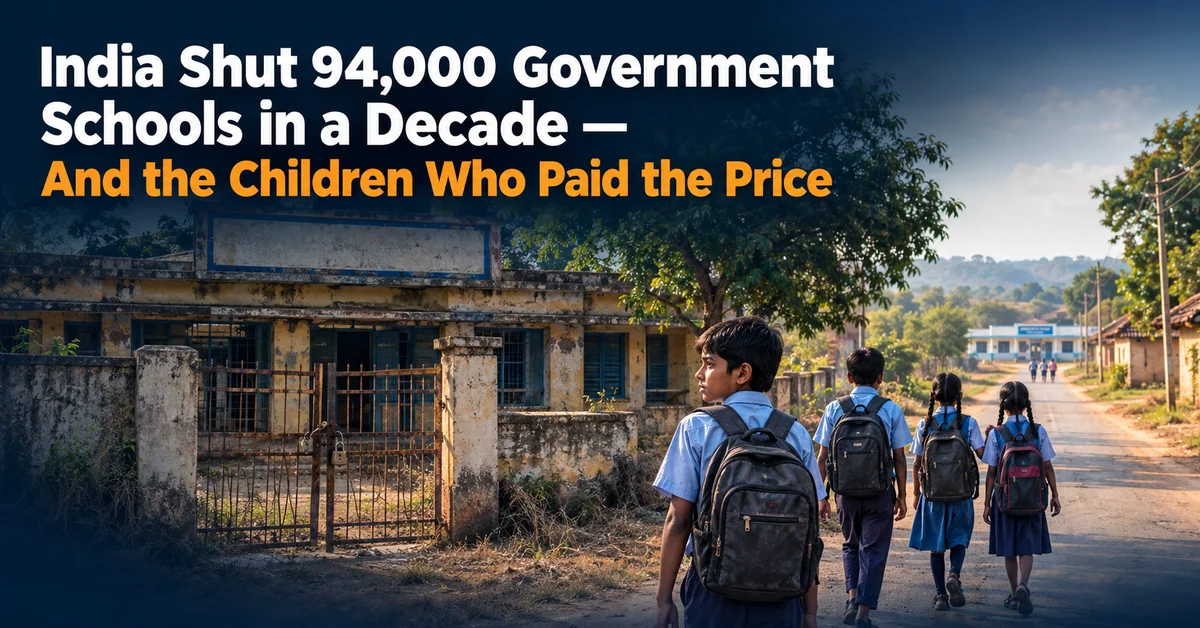
India Shut 94,000 Government Schools in a Decade — And the Children Who Paid the Price
That is not a statistic that is easy to sit with. Every single day for the past ten years, somewhere in India, a government school closed its gates — permanently. The building may still stand. The classrooms may still exist. But the school, as a functioning institution that children could walk to in the morning and walk home from in the afternoon, is gone.

CBSE Is Teaching AI to Children from Class 3 — And It Is Changing Everything
I remember when I was eight years old. In classrooms the newest gadget was a calculator if you were lucky. The thought that a primary school child could spend a class learning how AI thinks makes decisions and changes the world would have felt like science fiction.
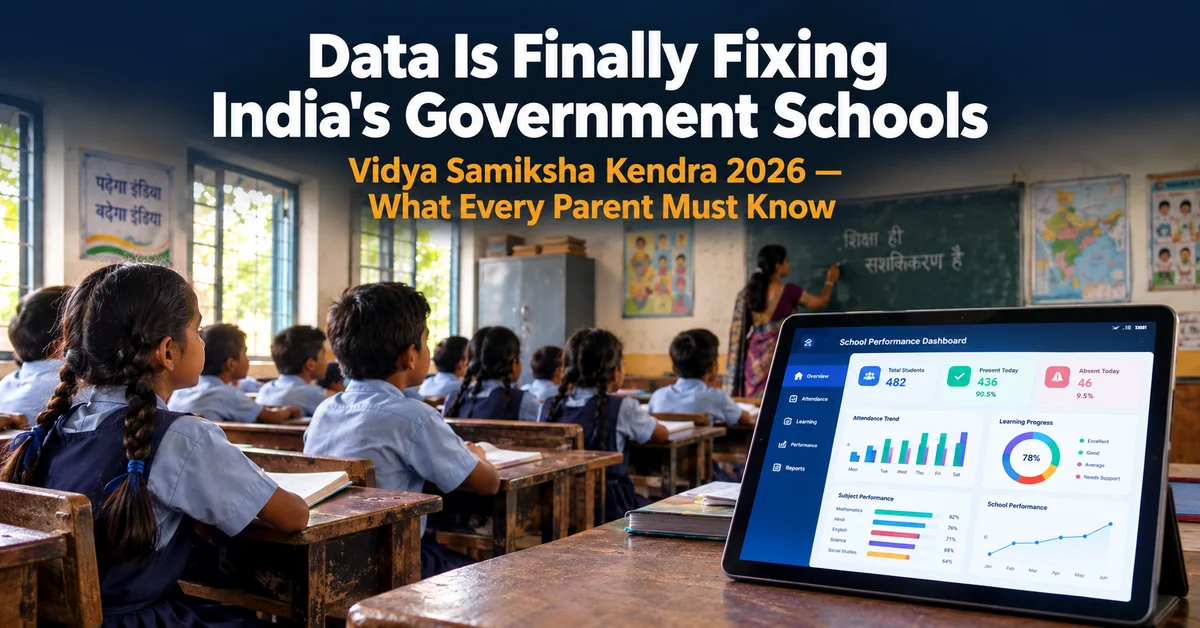
Vidya Samiksha Kendra 2026 — How Data Is Finally Fixing India's Government Schools
For years the government school system in India has worked in a way that was hard to understand. Teachers were often not there. There was no good way to track that. Students started falling and by the time anyone noticed it was usually too late. Shown in exam results months later. Schools often didn't have textbooks and important information sat in a book that no one ever looked at.